

Latest News
Nigeria Leads As ECOWAS Members Fail To Obey 150 Court Judgments


Nigeria Leads As ECOWAS Members Fail To Obey 150 Court Judgments
Nigeria and other member countries of the Economic Community of West African States (ECOWAS) have collectively neglected to adhere to a total of 150 court rulings issued by the bloc’s Court of Justice……READ ALSO Nigeria Leads As ECOWAS Members Fail To Obey 150 Court Judgments
According to Punch, the court’s records reveal that all ECOWAS nations and certain institutions within the organization have outstanding judgments awaiting enforcement. As of January 31, 2024, Nigeria topped the list with 43 unenforced judgments, followed by the Republic of Togo with 23, and Guinea with 14.
Other countries include Mali with 11, Niger with nine, Senegal with eight, Sierra Leone with seven, and Cote d’Ivoire with six. The Gambia has yet to enforce five judgments, while Benin Republic, Liberia, and Burkina Faso have four each. Ghana has three, and Cape Verde and Guinea Bissau have one each.
Additionally, the ECOWAS Commission has five judgments awaiting enforcement. Among the judgments that remain unenforced is the case between Petrostar Nigeria and Blackberry Nigeria Ltd, as well as EBID vs Cross River State. As of January 31, 2024, only 34 judgments had been implemented. Nigeria accounted for eight of these enforced judgments, including five from the Registered Trustees of Socio-Economic and Accountability Project.
In a notable case, SERAP sued the Federal Government over the shooting of peaceful protesters in Bundu Ama, Port Harcourt, in 2009. The ECOWAS court ruled that the Nigerian government violated its obligation to protect and respect the right to peaceful assembly, awarding a total of N11m in damages. Mali has implemented four judgments, Niger three, and The Gambia two, while Burkina Faso, Sierra Leone, and Liberia have each implemented one.
The ECOWAS Commission has enforced seven judgments, while the ECOWAS Parliament has enforced one. The enforcement of judgments within member states remains a significant challenge for the ECOWAS Court of Justice. Lateef Fagbemi (SAN), the Attorney General of the Federation and Minister of Justice, has urged the ECOWAS court to refrain from issuing orders and judgments that are difficult to enforce, emphasizing the need to consider the unique circumstances of member countries.
However, human rights lawyer Femi Falana (SAN) disagreed, stating that not all ECOWAS member states disregard court judgments like Nigeria. Falana linked the disregard for court orders in some West African countries to past military and apartheid regimes and highlighted the need for a shift towards respecting the rule of law. Meanwhile, Justice Olukayode Ariwoola, President of the ECOWAS Judicial Council, announced the inauguration of two committees to investigate member states’ disobedience to court judgments, following a closed-door meeting with President Bola Tinubu at the State House.
Join our channel for more latest news https://whatsapp.com/channel/0029VaV4jB6DuMRgwqnJCF32


-
 Latest News2 weeks ago
BREAKING: Tinubu Appoints New NIPC, NEPZA Board Chairpersons
-

 Politics2 weeks ago
Seyi Makinde Makes Big 2027 Move, Names Running Mate
-

 Entertainment2 weeks ago
We Tried” — Diamond Platnumz’s Wife Announces End Of Marriage
-

 Latest News1 week ago
 -

 Latest News1 week ago
El-Rufai Makes Major Move, Withdraws Three Applications In Corruption Case
-

 Latest News6 days ago
APC Kicks Off 2027 Candidate Upload On INEC Portal
-

 Politics1 week ago
Malami Makes Political Move, Names ADC Deputy Gov Candidate In Kebbi
-

 Gist6 days ago
Tinubu Appoints Three Oyo Indigenes To Key Federal Positions
-

 Latest News1 week ago
Full List: Edo Governor Announces 20 New Appointments
-
 Latest News5 days ago
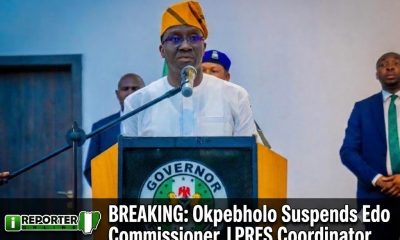
BREAKING: Okpebholo Suspends Edo Commissioner, LPRES Coordinator
-

 Politics2 weeks ago
Umahi Breaks Silence Over Lady’s Death Inside His Residence
-

 Latest News1 week ago
Lukman Walks Away From ADC, Faults El-Rufai