


Latest News
Obaseki and MOWAA: A Public Legacy Wrapped in Private Control?

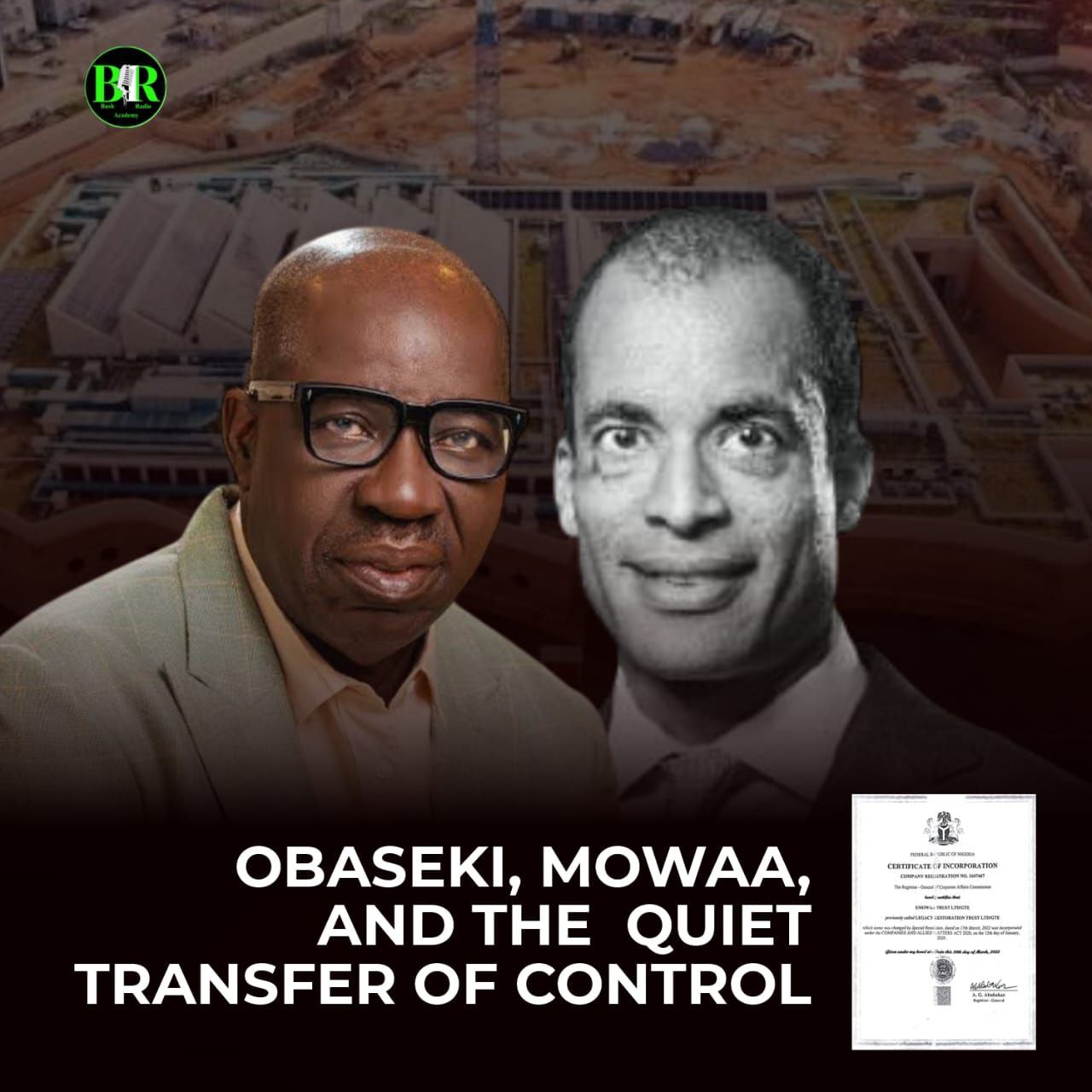
Obaseki and MOWAA: A Public Legacy Wrapped in Private Control?
When the Museum of West African Art (MOWAA) was unveiled, it was framed as a cultural rebirth — a legacy project rooted in Edo history and built on a partnership involving the Edo State Government, national institutions, and the Benin Palace. It was presented as public-spirited, heritage-driven, and institutionally anchored.
However, a review of incorporation documents, amended governance papers, and Corporate Affairs Commission (CAC) filings tells a more complex and troubling story — one marked by structural contradictions, quiet governance changes, and unresolved questions about control.
A Public Narrative, a Private Legal Vehicle
MOWAA is not a government agency. It is registered as a private Company Limited by Guarantee (LTD/GTE), originally incorporated on 13 January 2020 under the name EMOWAA Trust Ltd/GTE before later becoming Museum of West African Art Ltd/GTE.
In law, a LTD/GTE is controlled not by sentiment or public messaging, but by its registered members and guarantors. These are the persons with the authority to appoint directors, approve resolutions, and ultimately steer the organisation.
This distinction is critical — because while MOWAA’s public documents describe an institutional partnership, CAC filings show a different configuration.
The Membership Discrepancy
Amended Articles of Association state that the “members” of MOWAA comprise the Edo State Government, the National Commission for Museums and Monuments (NCMM), the Royal Palace of Benin, and independent directors.
Yet CAC records list private individuals as the registered guarantors and members of the company.
In governance terms, this is not a cosmetic issue. In a LTD/GTE structure, registered members are the legal source of power. If institutions are not properly reflected at CAC level, their authority exists largely in narrative rather than enforceable corporate control.
Who Appoints the Board?
The Articles further provide that directors are appointed by the members. This places enormous importance on who qualifies as a member in law, not just in principle.
If institutional partners are not clearly established as registered members, then questions naturally arise:
Who has been appointing directors?
Who has the power to remove them?
And who ultimately controls board composition?
These questions became sharper following a series of documented board changes.
The Quiet Changing of Names
CAC filings show that on 4 February 2022, key directors were formally removed from the board. Another significant round of resignations and fresh appointments occurred on 23 October 2024, again altering the governance landscape.
While these changes were legally filed, what remains unclear is which institutional stakeholders initiated or approved them. No publicly accessible documentation shows clear nomination trails from Edo State Government, NCMM, or the Benin Palace corresponding to these restructurings.
In public-interest projects, trustee and board changes typically follow transparent institutional processes. When such changes occur quietly, without clear attribution, they raise legitimate governance concerns.
A Quorum Clause That Raises Eyebrows
Further scrutiny of the Articles reveals that a general meeting quorum is defined as a majority of five members. Yet if effective registered membership is limited or unclear, this clause appears misaligned with reality.
Such inconsistencies suggest either a governance template that was never fully reconciled with actual filings, or a structure that evolved without adequate harmonisation between narrative and law.
Public Funds, Private Levers
There is documented evidence that Edo State Government funds were applied to the MOWAA project ecosystem, including counterpart funding and construction-related expenditures during the period of the administration of Godwin Obaseki.
Funding, however, does not automatically translate to control.
The critical unanswered question is whether the public funding was matched with clear, enforceable governance rights — membership status, voting power, or appointment authority — that protect public interest within the company’s legal framework.
The Iheanacho–Afriinvest Question
One recurring figure in MOWAA’s governance documents is Phillip Iheanacho, listed as a guarantor, director, and signatory to key resolutions.
Iheanacho is widely known within Nigeria’s financial sector and has longstanding professional associations linked to Afriinvest, a firm historically associated with Obaseki’s career in investment banking and asset management.
No document reviewed makes a criminal allegation or asserts illegality. However, in governance and public accountability, proximity matters. When a publicly funded cultural project is legally controlled through structures dominated by individuals with close professional links to the sitting governor of the time, the optics alone demand scrutiny.
Questions That Remain
Taken together, the documents raise fundamental issues:
A public partnership narrative sits uneasily beside private control markers.
Institutional membership is asserted in Articles but not clearly reflected in CAC guarantor records.
Board and trustee changes occurred without transparent institutional attribution.
Public funds were committed without corresponding clarity on enforceable public governance rights.
These are not artistic questions. They are governance questions.
Part One of a Larger Story
This examination focuses on structure, control, and governance. It does not yet interrogate the financial dimension.
That comes next.
This is Part One of the MOWAA investigation.
Part Two will examine the cost implications — procurement, construction figures, counterpart funding, and what Edo State and Nigerians ultimately paid for this legacy project.
🎙️ Truth Unveiled
Osigwe Omo-Ikirodah is the Principal and CEO of Bush Radio Academy.

-
 Latest News2 weeks ago
No Excuse For This “Shameful Act” — APC Fires Back At Makinde Over Controversial Oba Coronation
-
 Latest News2 weeks ago
Sh*ck Move: Cameroon’s President Biya Names His Son Vice President
-
 Latest News1 week ago
Presidency Fires Back At ADC: ‘We Won’t Close Shop Because You’re Struggling
-
 Latest News3 days ago
Iyabo Obasanjo Responds As Senator Yayi Emerges Ogun APC Consensus Candidate
-
 Latest News6 days ago
It’s Obvious I Don’t Own What You Have” – Lamido Blasts Malami Over ‘Thief’ Claims
-
 Latest News1 week ago
APC Blocks Bala Mohammed’s Defection — Here’s Why
-

 Latest News1 week ago
A Birthday Fit For A Legend : Watch Abubakar Momoh Make A Grand Entrance At Adams Oshiomhole’s Residence
-
 Latest News1 week ago
Keyamo Slams Peter Obi, Kwankwaso: ‘They Think They Can Blackmail Everyone
-
 Latest News2 weeks ago
Sh*ck Exit: Akinwumi Steps Down As ADC Secretary
-
 Latest News1 week ago
Former VP Osinbajo Lands Powerful Global Appointment
-
 Latest News5 days ago
Tony Akiotu Has Been Appointed As The New Chairman Of The Broadcasting Organisations Of Nigeria
-
 Latest News2 days ago
Why We’re Tolerating Wike – APC Chair Yilwatda Speaks Out