


Tinubu Reveals Major Security Breakthrough As Nigerian Forces Eliminate, Arrest 4 Top Terrorist Leaders
 Follow us on Google News
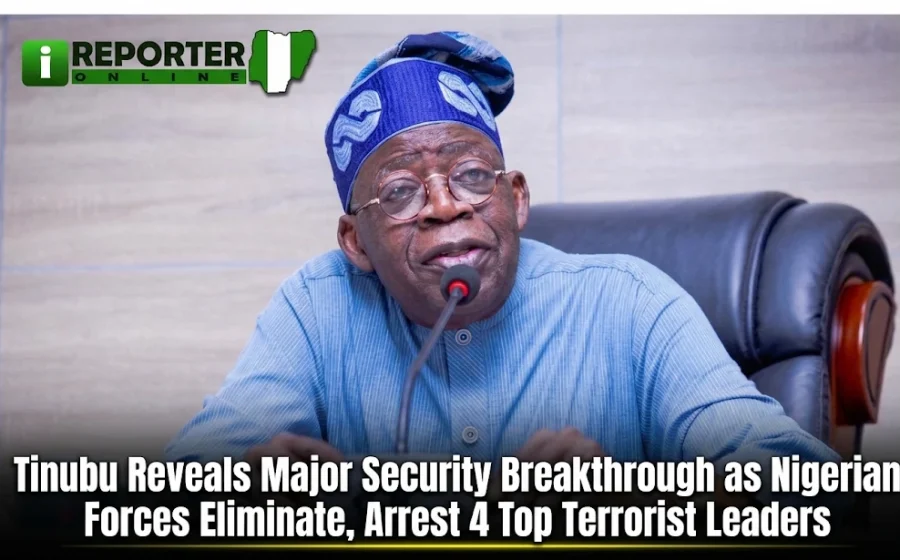
President Bola Tinubu has disclosed that Nigerian security forces have successfully killed or arrested four of eight identified senior terrorist leaders, describing the development as a significant breakthrough in the country’s ongoing fight against terrorism.
The President, who was represented by the National Security Adviser, Mallam Nuhu Ribadu, made the disclosure on Monday during the opening of the 2026 Chief of Defence Intelligence (CDI) Annual Conference in Abuja.
Tinubu identified the elimination of a senior Islamic State leader, Abu Bilal al-Minuki, in May 2026, alongside the arrest of Omar Hassan Ma’adou, as notable achievements recorded by the country’s security agencies.
According to the President, the operations demonstrate the increasing effectiveness of Nigeria’s security architecture and the determination of the current administration to dismantle terrorist networks across the country.
He stated that four of the eight identified senior terrorist figures had either been killed or taken into custody under his administration, adding that the security forces would sustain pressure on terrorist commanders, their financial networks, logistics and recruitment channels.
Tinubu maintained that the government’s objective was to ensure that military victories translate into lasting peace and improved security for Nigerians.
The President further observed that the country’s security challenges had become increasingly complex, with terrorism, banditry, kidnapping, cybercrime and transnational organised crime becoming more interconnected and heavily influenced by technological advancements.
He also revealed that more than 1,000 convictions had been secured following over 2,000 terrorism-related trials conducted in recent years, describing the development as part of broader efforts to strengthen accountability and combat insecurity.
Speaking on the situation in the Niger Delta, Tinubu disclosed that incidents of illegal oil bunkering and vandalism of critical oil and gas infrastructure had recorded a significant decline in 2026.
He explained that reported incidents dropped from 52 in the first quarter to 21 in the second quarter and further declined to 17 in the third quarter, representing a 46.8 per cent reduction between the first and third quarters.
The President attributed the improvement to sustained security operations, enhanced intelligence gathering and coordinated efforts by relevant security agencies to protect the country’s critical infrastructure.
He assured Nigerians that his administration would continue to intensify efforts to dismantle criminal networks, safeguard vulnerable communities and strengthen national security, particularly as the country approaches the 2027 general elections.
Tinubu stressed that every Nigerian deserved to live, work and participate in democratic activities without fear of violence or intimidation.
On intelligence gathering and military operations, the President called for the modernisation of Nigeria’s intelligence architecture through the adoption of emerging technologies, including artificial intelligence, machine learning, geospatial intelligence and unmanned surveillance systems.
He, however, warned that technological advancement must be supported by effective oversight and human verification to ensure accuracy, accountability and responsible application.
Tinubu also disclosed that he had directed the Special Adviser on Homeland Security, Maj.-Gen. A.A. Fong, to coordinate the development of a comprehensive national security strategy alongside a five-year rolling strategic operational plan.
He emphasised the importance of stronger cooperation among the Armed Forces, Defence Intelligence Agency, National Intelligence Agency, Department of State Services, Nigeria Police Force and other relevant security institutions, noting that intelligence sharing remained crucial to defeating emerging security threats.
Earlier, the Minister of Defence, retired General Christopher Musa, commended intelligence personnel for their contributions to safeguarding the country, urging them to remain proactive and committed to addressing evolving security challenges.
Similarly, the Chief of Defence Staff, General Olufemi Oluyede, described intelligence as a critical component of successful military operations, calling for increased investment in artificial intelligence, advanced data analytics and modern surveillance technologies.
The conference, organised by the Defence Intelligence Agency, is themed, “Optimising Intelligence through Technological Innovations for Effective Strategic Operations in a Complex Security Environment.”
The event also coincides with the 40th anniversary of the National Security Agencies Act of 1986.





Comments
0 comments