

Reps Move Against Nine Universities Over Alleged Financial Mismanagement – Probe Begins
 Follow us on Google News
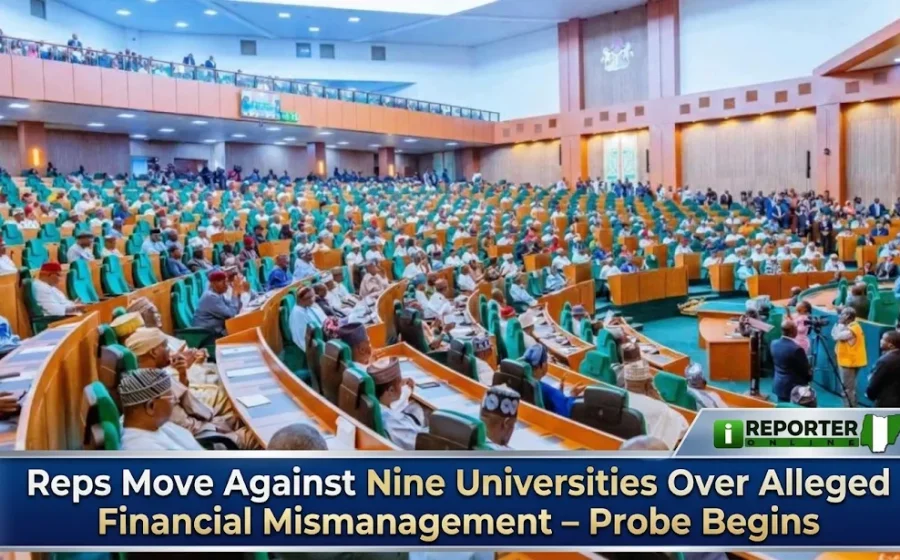
The House of Representatives Committee on University Education has commenced an investigation into alleged financial irregularities involving nine federal universities and other tertiary institutions, demanding detailed explanations from their managements over the utilisation of public funds.
The investigation follows concerns over inconsistencies in financial statements, inadequate transparency and possible violations of government budgetary regulations across some institutions.
As part of the exercise, the committee has directed the Vice-Chancellor of the University of Lagos (UNILAG), Professor Folasade Ogunsola, to submit the institution’s budget records for 2024, 2025 and 2026 and appear before lawmakers next week to address an alleged N7.1 billion discrepancy in its financial accounts.
The committee chairman, Abubakar Fulata, disclosed this on Saturday in a statement following an oversight visit to universities and inter-university centres across the South-West region.
According to Fulata, the committee discovered several inconsistencies in the financial documents presented by some institutions, raising concerns about how their revenues and expenditures were calculated and accounted for.
He questioned situations where universities reported spending more money than they generated without providing explanations for the additional funds. He also expressed concern over institutions that declared substantial internally generated revenue but failed to account adequately for the unspent balances.
The lawmaker cited an instance where an institution reportedly generated N9 billion but recorded expenditure of N10 billion, questioning the source of the additional N1 billion.
He also referenced another financial report showing N12 billion in generated revenue against N8 billion in expenditure, with no satisfactory explanation provided for the remaining N4 billion.
Fulata urged university vice-chancellors and their management teams to prioritise transparency, accountability and proper financial documentation, stressing that public institutions must account for both government allocations and internally generated revenue.
He maintained that effective financial management was essential to improving the quality of university education and ensuring that public resources were utilised for their intended purposes.
The committee chairman further assured that preparations for the 2027 general elections would not interfere with the lawmakers’ constitutional oversight responsibilities, insisting that the National Assembly would continue monitoring government institutions.
Meanwhile, the committee has directed the University of Lagos, Obafemi Awolowo University, Ile-Ife, Federal University Oye-Ekiti, Federal University of Technology, Akure, and Federal University of Health Sciences, Ila-Orangun, to update their financial records and provide comprehensive reports on the implementation of their 2024, 2025 and 2026 budgets.
The directive followed concerns raised during the inspection exercise over the accuracy and completeness of financial information submitted by the institutions.
Reports from the oversight visit indicated that Professor Ogunsola was unavailable when the committee visited UNILAG. Officials who represented her were reportedly unable to provide satisfactory explanations regarding the alleged N7.1 billion discrepancy in the university’s 2024 and 2025 financial records.
Other institutions inspected by the lawmakers included the University of Ibadan, Adeyemi Federal University of Education, Ondo, Federal University of Agriculture and Development Studies, Iragbiji, Federal University of Technology and Environmental Studies, Iyin-Ekiti, and the Nigeria French Language Village, Badagry.
Beyond financial accountability, the committee also urged university authorities to comply with the federal character principle in staff recruitment and student admissions to ensure fairness and balanced representation.
The lawmakers explained that the investigation forms part of the National Assembly’s constitutional responsibility to examine public expenditure, monitor budget implementation and ensure accountability in the management of government resources.
They added that the exercise would help identify financial and administrative shortcomings while strengthening transparency and improving service delivery across Nigeria’s tertiary education sector.



Comments
0 comments