


CBN Holds Interest Rate At 26.5% Amid Economic Concerns
 Follow us on Google News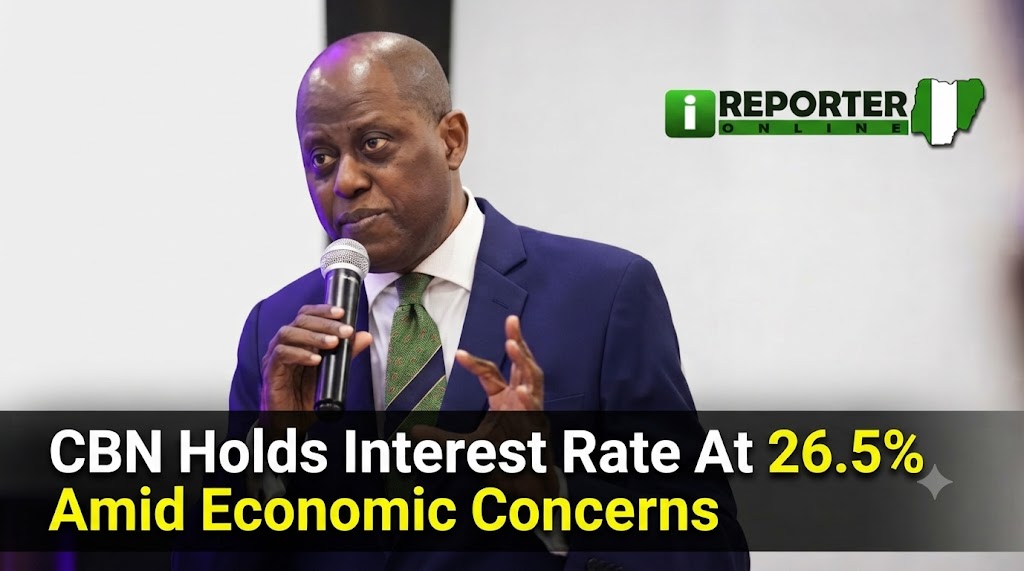
The Central Bank of Nigeria (CBN) has retained the Monetary Policy Rate (MPR) at 26.5 percent, maintaining its current stance on interest rates amid ongoing economic uncertainties.
According to Ireporter Online, the decision was announced on Tuesday by CBN Governor Olayemi Cardoso at the conclusion of the 305th meeting of the Monetary Policy Committee (MPC) held in Abuja.
The apex bank maintained the benchmark interest rate at 26.5 percent for the second consecutive time, as the committee opted to sustain the existing monetary policy direction.
“The Committee decided as follows: retain the monetary policy rate at 26.5 percent,” Cardoso stated.
The MPC also kept other major monetary policy indicators unchanged, including the asymmetric corridor around the MPR at +500/-100 basis points. The Cash Reserve Ratio (CRR) for Deposit Money Banks remained at 45 percent, Merchant Banks at 16 percent, while the liquidity ratio was retained at 30 percent.
Cardoso explained that the decision followed a detailed review of Nigeria’s economic situation and emerging global challenges, particularly renewed conflicts in the Middle East and their possible impact on international commodity prices.
He noted that while Nigeria’s headline inflation recorded a slight decline in June, global uncertainties required the committee to maintain a careful and measured approach.
According to the CBN governor, the continued instability in the Middle East could push up global energy prices and increase inflationary pressures through higher fuel and transportation costs.
“Maintaining a cautious monetary policy stance remains appropriate in view of the evolving developments,” Cardoso said.
The MPC, however, expressed confidence that Nigeria’s economy remained strong enough to withstand external pressures, attributing the resilience to ongoing fiscal and monetary reforms introduced by the government and the central bank.
Cardoso added that keeping the current policy position would allow the committee to continue monitoring economic trends and incoming data before considering any future adjustments.
The committee also praised improved coordination between fiscal and monetary authorities, saying the collaboration had helped reduce the impact of global economic challenges on the Nigerian economy.







Comments
0 comments