


Elon Musk Unveils Flying Tesla Roadster That Can Hit 60mph In Under One Second
 Follow us on Google News
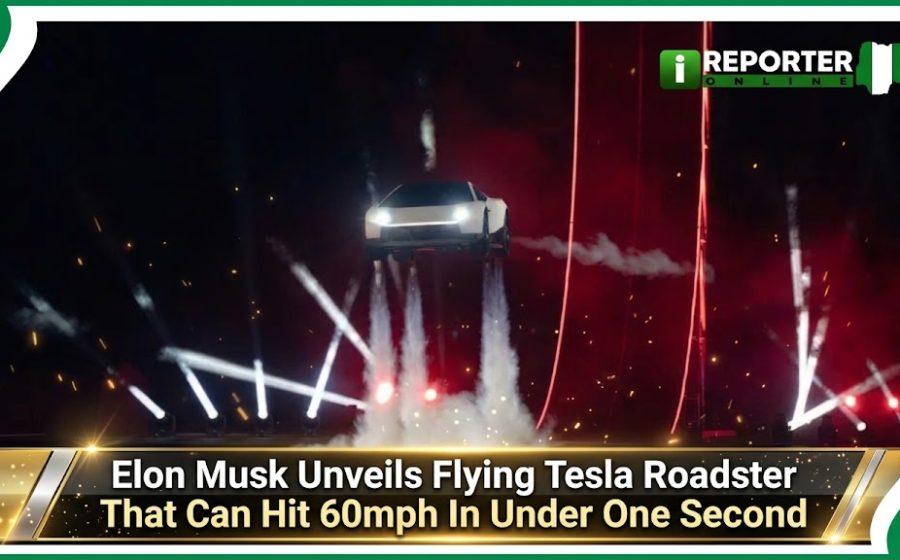
Tesla and SpaceX chief executive Elon Musk has unveiled a futuristic Tesla Roadster capable of performing aerial stunts using high-pressure air jets, sparking excitement and raising questions about the future of flying vehicles.
The vehicle was demonstrated on Thursday at a SpaceX test facility in Texas, where it reportedly climbed a steep ramp, flipped in the air and landed with the assistance of its jet system. During the presentation, the two-seater sports car also jumped over a line of parked Tesla vehicles.
Musk claimed that the Roadster could accelerate from zero to 60 miles per hour in less than one second with the aid of jets fitted at the rear of the vehicle. However, no driver was inside the car during the demonstration, with Musk explaining that the precaution was taken to avoid potential injuries if anything went wrong.
“Success is not guaranteed,” Musk told the audience, acknowledging the possibility of failure during the demonstration.
The vehicle reportedly uses 10 nozzles connected to high-pressure air tanks to generate the force required for its brief aerial movements. Musk said the technology was developed through collaboration between Tesla and SpaceX.
He also announced plans to begin production of the Roadster in 2028, although the demonstration did not establish that the vehicle could sustain flight or travel long distances like a conventional aircraft.
Musk said he wanted the presentation to show that the technology was real rather than a product of artificial intelligence or visual effects.
Despite the dramatic display, aviation experts have raised concerns about the safety, cost and engineering challenges associated with developing a vehicle capable of operating effectively on roads and in the air.
Roger Connor, a curator specialising in vertical flight at the Smithsonian’s National Air and Space Museum, told CNN that combining the requirements of road vehicles and aircraft would present significant design challenges.
He explained that aircraft must be lightweight to achieve efficient flight, while road vehicles require additional structural features, including bumpers and crumple zones, to protect occupants during collisions. Such safety components could increase a vehicle’s weight and make flight more difficult.
Connor also warned that attempting to combine both functions could result in an expensive vehicle that struggles to perform either task efficiently.
Tesla is not the only company exploring flying-car technology. California-based startup Alef is also developing a vehicle designed to take off vertically using multiple propellers.
Alef chief executive Jim Dukhovny has previously highlighted the technical difficulties involved in transitioning from vertical take-off to forward flight while maintaining stability.
Connor similarly questioned whether a road-legal vehicle such as the Tesla Roadster could remain airborne over extended distances, suggesting that the demonstration was more accurately described as a brief jump than sustained flight.
Although Musk’s presentation offered a glimpse of an ambitious approach to vehicle design, questions remain about the Roadster’s practical capabilities, safety requirements, affordability and readiness for commercial production.



Comments
0 comments