

How Boko Haram Started” — Emir Sanusi Reveals What Fueled Nigeria’s Terrorism Crisis
 Follow on Google News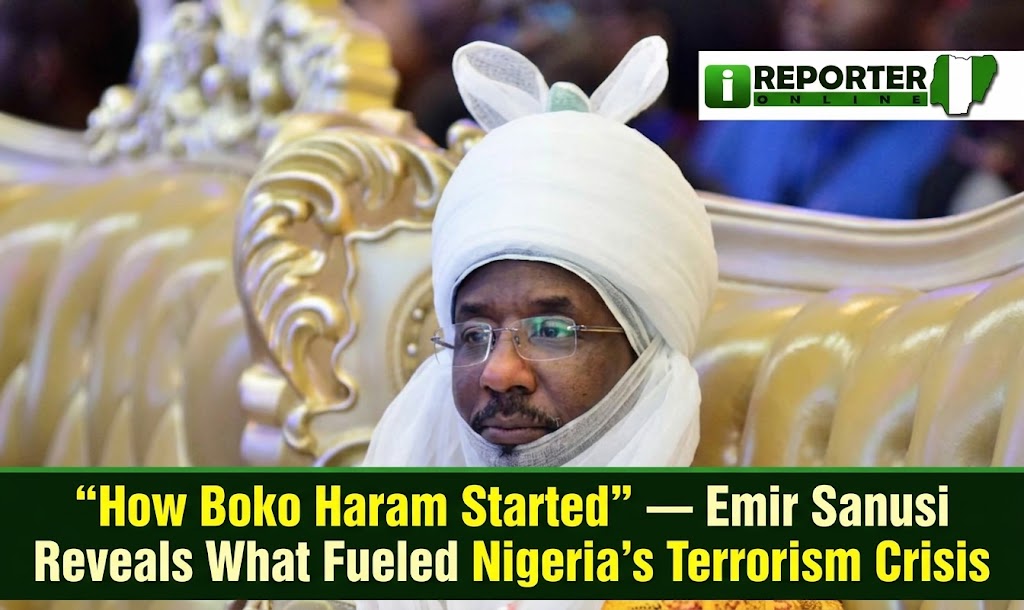
The Emir of Kano, Muhammadu Sanusi II, has identified divisive political rhetoric and the politicisation of ethnic and religious identities as factors that, in his view, created an environment in which Boko Haram, banditry and other forms of insecurity could emerge and gain traction in Nigeria.
Sanusi made the remarks on Wednesday in Abuja while speaking at the public presentation of a book documenting the leadership and reforms of retired Lieutenant General Tukur Yusufu Buratai during his tenure as Chief of Army Staff.
According to reports, the former Governor of the Central Bank of Nigeria (CBN) argued that Nigeria’s security challenges should not be examined solely through the lens of violent attacks, terrorism and criminal activities, but also in the context of longstanding social and political divisions.
He said the repeated categorisation of Nigerians along ethnic, regional and religious lines had contributed to an environment that could facilitate the emergence of violent movements.
“The fundamental point I wish to emphasise is that the security crisis in this nation did not commence with violence as we currently witness it, nor did it commence with banditry. It did not commence with Boko Haram and terrorism,” Sanusi said.
According to him, divisive language in political discourse and the media had increasingly encouraged Nigerians to view themselves as Northerners and Southerners, Muslims and Christians, as well as members of different ethnic groups, rather than primarily as Nigerians.
Sanusi warned that continued emphasis on such divisions could create conditions for further insecurity, urging Nigerians to strengthen their sense of national identity and focus on development.
“We are only laying the foundation for a new round of violence. We have to go back to seeing ourselves as Nigerians, as people committed to this country, and focus on what is important, which is the development of our people,” he said.
The Emir also called on politicians to concentrate on providing essential services, including education, healthcare and economic opportunities, rather than making religion a central part of political competition.
“It is not the responsibility of politicians to give us religion. They are there to give us education, to give us healthcare, to give us an economy and allow the religion to be in the hands of those who are religious leaders,” he said.
Sanusi similarly urged religious leaders to avoid excessive involvement in partisan politics, arguing that the blurring of the roles of religious and political leaders could make it more difficult for citizens and institutions to hold political authorities accountable.
He further stressed the need for national institutions to adopt long-term planning beyond the four-year electoral cycle.
According to him, institutions such as the military, police and Central Bank need to operate with longer-term national objectives rather than being shaped primarily by electoral timelines.
“We have to think 20 years, 30 years, 50 years, whereas elected officers are thinking in four-year cycles,” Sanusi said.
His remarks came during an event focused on documenting the leadership and institutional reforms associated with Buratai’s tenure as Army Chief, with discussions also highlighting broader challenges surrounding Nigeria’s security architecture.






Comments
0 comments