

Nigeria Ranks Second Globally in Gas Flaring Surge Despite Worsening Power Crisis
 Follow on Google News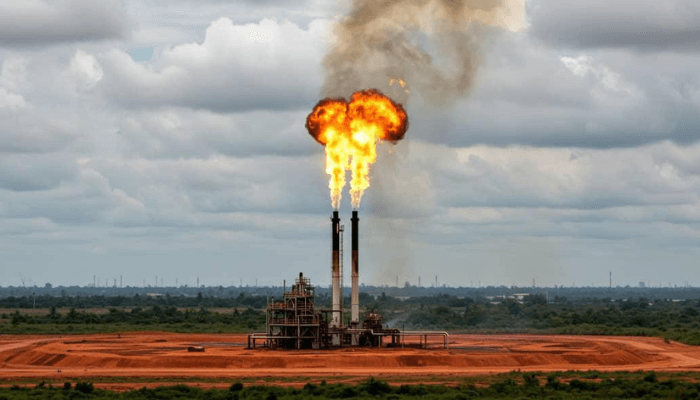
Nigeria has recorded the second-highest increase in gas flaring globally in 2024, despite widespread electricity shortages across the country and its pledges to cut emissions under international climate agreements. According to the latest Global Gas Flaring Tracker report by the World Bank, gas flare volumes in Nigeria surged by 12 percent last year, second only to Iran, marking the second consecutive year of rising flaring in Africa’s largest oil producer.
This increase in gas waste comes as over 90 million Nigerians continue to lack access to reliable electricity and manufacturers shut down or operate below capacity due to chronic power shortages. Despite a modest 3 percent growth in oil production in 2024, Nigeria’s flare intensity—the volume of gas flared per barrel of oil—rose sharply from 11.0 cubic meters per barrel in 2023 to 12.0 in 2024, more than twice the global average.
The report places Nigeria among the top nine gas flaring nations globally, alongside Russia, Iran, Iraq, the United States, Venezuela, Algeria, Libya, and Mexico. Collectively, these countries are responsible for over 75 percent of the world’s gas flaring, even though they produce less than half of the global crude oil supply.
The World Bank attributed the bulk of Nigeria’s flare increase to operational changes in the country’s oil sector. With international oil companies pulling out of onshore and shallow-water assets, the Nigerian National Petroleum Corporation (NNPC) and several smaller indigenous companies have taken over production. These firms accounted for 60 percent of total flare volumes and 75 percent of the increase in 2024. Many of these companies, the report noted, lack the technical expertise and financial capacity to invest in infrastructure for gas capture and utilization. The NNPC has also faced funding shortfalls, especially in joint ventures where it is a non-operating partner.
Despite Nigeria’s vast gas reserves, industry experts say commercial bottlenecks, weak regulatory enforcement, poor grid infrastructure, and limited access to financing continue to stall the development of gas-to-power projects. Most smaller companies do not have commercial access rights to the Bonny LNG terminal, further limiting options for export and domestic utilization.
The federal government’s efforts to address gas flaring through the Nigerian Gas Flare Commercialisation Programme (NGFCP), launched in 2020, have yielded limited results. In late 2023, the government awarded contracts to 38 firms to address 40 flare sites, and four other companies were selected to manage nine more sites using a cluster approach. However, implementation has been slow, hampered by challenges around site access, regulatory delays, and financial constraints.
Beyond the economic loss, flaring poses serious environmental and health risks. The release of greenhouse gases and local pollutants affects communities near oil fields, and experts warn that Nigeria’s increasing flare volumes could undermine its credibility in international climate talks, especially as it continues to seek climate financing.
“There’s a growing credibility gap between what Nigeria says at climate summits and what’s happening on the ground,” said Charles Akinbobola, an environmental policy analyst. He urged the government to adopt stricter enforcement, provide financial incentives, and invest in small-scale gas utilization technologies. Without bold action, he warned, the country risks locking itself into a cycle of energy poverty and environmental degradation.






Comments
0 comments