Chaos In Niger: Nigerian Soldiers Allegedly Burn Homes, Torture Wedding Guests In Violent Crackdown
“Villagers were blamed for paying ransoms to bandits,” says Babangida Kudodo, a youth leader in the Lakpma region. “The soldiers told them to use their money to buy guns and fight back.”
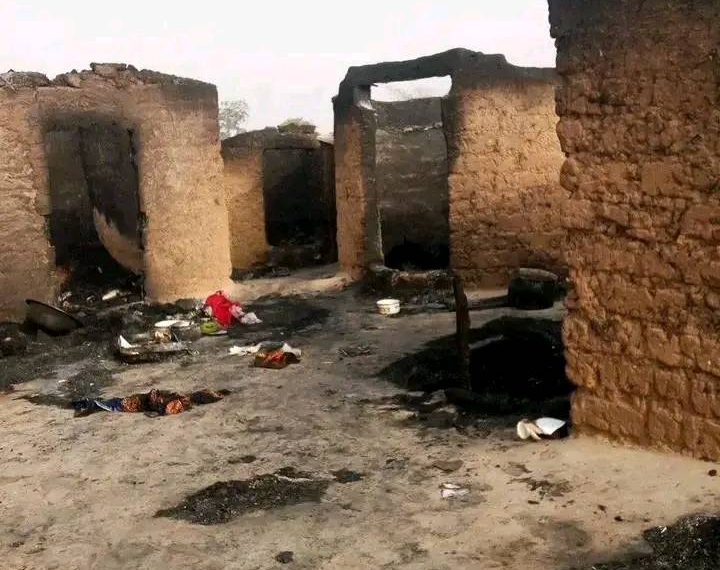
A shocking report has emerged detailing alleged human rights abuses by Nigerian soldiers stationed in Erena,…….READ MORE Shiroro Local Government Area of Niger State. While initial claims suggested that soldiers had targeted properties linked to the notorious bandit leader Dogo Gide in Chikuba, new findings indicate that the destruction primarily affected innocent rural dwellers, whose homes were burned, and who also faced severe mistreatment.
Dogo Gide, a feared bandit, has long terrorized communities across Niger, Kaduna, and Zamfara states. His gang was responsible for downing a Nigerian military aircraft in August 2023 near Kwaki, a village close to Chikuba, where soldiers carried out the latest operation.
The military action left devastation in Makera, Kudodo, and Sabon Gida in Chukuba, all part of the Lakpma riverine region, which comprises over 10 villages. A video recorded in the aftermath shows women wailing in the local Gbagyi dialect, mourning the destruction.
Locals and youth leaders from the affected areas fear that this incident will worsen the already dire hunger crisis, as at least 20 homes—made of clay and wood—were torched in Sabon Gida alone.
Eyewitnesses recount that the soldiers, while on routine patrol, disrupted a wedding in Makera and demanded to be led to bandit hideouts.
“But we don’t know where they are,” one villager, who was allegedly tortured, told PREMIUM TIMES through an informant.
“They started beating everyone, including Dagbe Kudodo, the imam who was blessing the wedding ceremony,” the man recounted, speaking under anonymity for security reasons.
Witnesses said soldiers confiscated 18 mobile phones from wedding guests before intensifying their interrogation. “They first questioned us as a group, then individually,” the source added.
Unable to withstand the brutality, some villagers collapsed. One attendee, Ibrahim Shehu, fainted during the ordeal, while another, Ibrahim Lakuta, lost three teeth, according to a source from Kudodo village.
Women and children were not spared. The soldiers reportedly destroyed the bride’s belongings, including her clothes and wedding gifts.
“The soldiers blamed villagers for paying ransoms and protection fees to bandits,” said Babangida Kudodo, a youth leader in Lakpma. “They told us to buy guns instead of giving money to criminals.”
Following the attack at the wedding, soldiers proceeded to Chukuba, a village about four kilometers from Paleli, where Dogo Gide’s family, including his mother, reportedly resides.
Ahmed Sarki, a youth leader from Chukuba, told PREMIUM TIMES that villagers fled after receiving warnings from Makera about the soldiers’ arrival.
At Chukuba, the soldiers allegedly fired indiscriminately before advancing to Sabon Gida, where they razed more than 20 homes, burning essential food supplies like maize and yam.
“The people are now facing starvation,” Sarki lamented. “The bandits had already restricted their farming, and now, the little they had stored has been destroyed by soldiers.”
Efforts to obtain comments from the Niger State Commissioner for Homeland Security, Garba Abdullahi, a retired major-general, have been unsuccessful. Similarly, the permanent secretary of the ministry, Aminu Aliyu, has not responded to inquiries.
This is not the first time Nigerian security forces have been accused of targeting civilians. Kurebe village in the same region has reportedly suffered more casualties from military actions than from terrorist attacks. In 2022, an airstrike intended for terrorists killed 14 villagers, including women and children, prompting calls for justice that were ignored by both the state government and the Nigerian Air Force.
These allegations are among the reasons why the International Criminal Court (ICC) has been investigating the Nigerian military for potential war crimes. However, the federal government under President Bola Tinubu has urged the ICC to halt its probe, arguing that it could demoralize troops fighting insurgents.
Meanwhile, the International Human Rights Commission (IHRC) has vowed to launch an independent inquiry into the recent military action in Niger State. Niger State IHRC Director Shuaibu Awaisu has indicated that legal action may be pursued to seek justice for the victims.
At the time of this report, Defence Headquarters spokesperson Onyema Nwachukwu has not responded to requests for comment.






 Politics1 week ago
 Latest News11 hours ago
 Politics2 days ago
 Latest News6 days ago
 Politics2 weeks ago
 Latest News6 days ago
 Latest News3 days ago
 Politics1 week ago
 Latest News2 weeks ago
 Politics5 days ago
 Entertainment1 week ago
 Latest News2 weeks ago