

Connect with us

Latest News

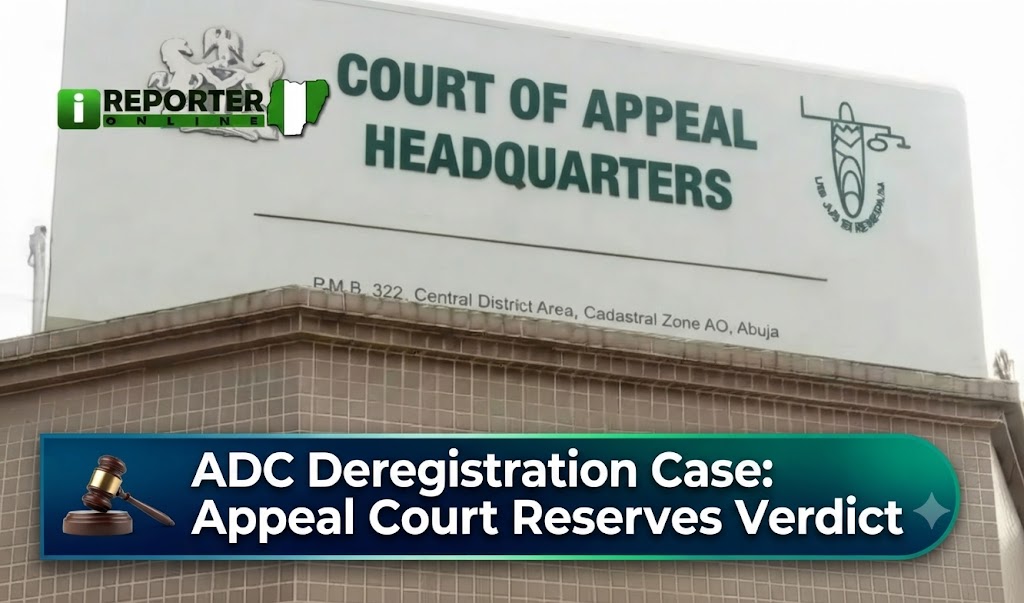
ADC Deregistration Case: Appeal Court Reserves Verdict

Published

on

9005ca78 54f7 4fcc 848b 26bf1e19d306

The Court of Appeal in Abuja has reserved judgment in the appeals challenging the Federal High Court’s order directing the Independent National Electoral Commission (INEC) to deregister the African Democratic Congress (ADC) and four other political parties.

According to Ireporter Online, a three-member panel of the appellate court, led by Justice Abba Mohammed, announced that the matter was ready for judgment after counsel representing all parties adopted their written arguments.

The affected political parties include the African Democratic Congress (ADC), Action Peoples Party (APP), Action Alliance (AA), Accord Party (AP), and Zenith Labour Party (ZLP).

The court stated that the date for delivering its judgment would be communicated to the parties involved.

Advertisement

The development follows an earlier decision by the Court of Appeal on June 16, where it suspended the enforcement of the Federal High Court ruling pending the determination of the appeals.

The appellate court had also expressed concern over the actions of the trial judge, Justice Peter Lifu, for proceeding with the case despite an earlier directive ordering him to suspend proceedings.

On May 22, the Court of Appeal had instructed Justice Lifu to halt further proceedings pending the resolution of an interlocutory appeal filed by the parties. The panel noted that the trial judge was aware of the order but went ahead to deliver judgment.

Describing the action, the appellate court referred to it as “a form of judicial impertinence,” while citing a previous Supreme Court decision that characterised disregard for a superior court’s order as “judicial rascality” and conduct that could question a judge’s suitability for the bench.

Advertisement

The controversy began after Justice Lifu of the Federal High Court ordered INEC to deregister the five political parties, ruling that they failed to meet constitutional requirements for retaining their registration.

The court also barred INEC from recognising the parties or accepting their candidates for future elections, including the 2027 general elections. It further directed officials of the affected parties to stop presenting themselves as representatives of registered political organisations.

The judgment followed a suit filed by the National Forum of Former Legislators, which challenged the continued recognition of political parties that failed to meet stipulated electoral performance requirements.

The former lawmakers argued that Section 225A of the 1999 Constitution, as amended, alongside provisions of the Electoral Act 2022 and INEC regulations, empowered the electoral body to deregister parties that failed to meet required benchmarks.

Advertisement

They maintained that political parties must secure at least 25 per cent of votes cast in a state during a presidential election or win at least one elective position at the federal, state, or local government level to maintain their registration.

The plaintiffs alleged that the five political parties failed to achieve the required threshold during the 2023 general elections and subsequent by-elections, arguing that allowing them to remain registered could weaken the credibility of Nigeria’s electoral system.

Advertisement
Click to comment
Subscribe
Notify of
guest
0 Comments
Oldest
Newest Most Voted

Trending

0
Would love your thoughts, please comment.x
()
x