

Education
VIDEO: ₦50,000 WAEC, NECO Fee Hike Triggers Outrage

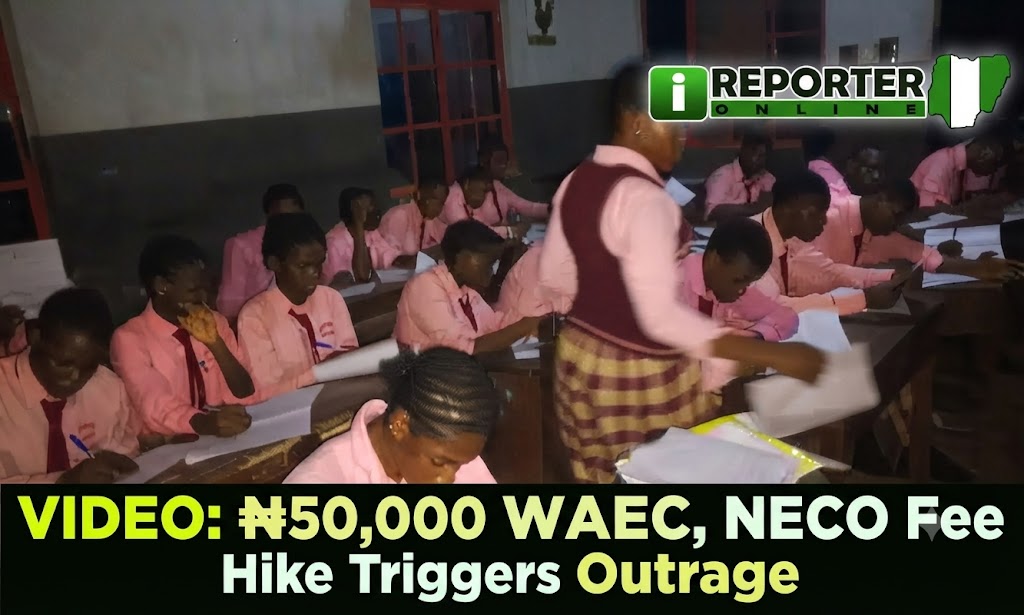
The Federal Government has come under intense criticism following its approval of a new ₦50,000 registration fee for candidates sitting the West African Examinations Council (WAEC) and the National Examinations Council (NECO) Senior School Certificate Examinations, with the new charge set to take effect from 2027.
According to Ireporter Online, the newly approved fee represents an increase of approximately 82 percent from the current ₦27,500 registration cost, making it one of the steepest hikes in public examination fees in recent years.
The approval was contained in a letter dated June 18, 2026, signed by the Director of Senior Secondary Education at the Federal Ministry of Education, Adeniji Ibrahim. The directive followed a request by WAEC for an upward review of examination fees, citing the increasing cost of conducting national examinations.
The ministry explained that the decision was reached after a meeting between the Minister of Education and examination bodies on March 31, 2026, where concerns over rising operational expenses prompted a directive for WAEC and NECO to adopt a uniform registration fee for their Senior School Certificate Examinations.
The Federal Ministry of Education has since confirmed that the ₦50,000 fee has received official approval and will become effective with the 2027 NECO Senior School Certificate Examination. Relevant stakeholders are also expected to be notified ahead of its implementation.
Although the ministry did not provide a detailed breakdown of the factors behind the increase, examination bodies have consistently pointed to escalating costs associated with printing examination materials, logistics, security, supervision, transportation, technology deployment and general administration.
The decision has, however, generated widespread concern among education experts, private school owners and political leaders, who argue that the increase could further strain Nigerian families already battling economic hardship. They warned that the higher examination fee could force more students out of school, discourage enrolment and widen educational inequality.
Stakeholders also expressed fears that state governments operating free or subsidised WAEC and NECO registration schemes would face heavier financial obligations, while states already struggling with limited resources may find it difficult to sustain such programmes.
National Mobilisation Officer of the Education Rights Campaign, Adaramoye Michael Lenin, described the decision as counterproductive, insisting it contradicts the government’s stated commitment to improving access to education. He argued that the increase would likely worsen Nigeria’s out-of-school children crisis, as many struggling parents may be unable to afford the new charges.
Lenin further maintained that introducing higher examination fees during a period of inflation, declining purchasing power and widespread economic hardship could discourage students from completing their secondary education and called on the government to immediately reverse the decision.
Similarly, the President of the National Association of Proprietors of Private Schools, FCT chapter, Dorothy Okwuenu, condemned the increase, describing it as unfortunate and warning that it could undermine efforts aimed at improving school retention.
According to her, many parents are already burdened by rising tuition, transportation, textbooks, feeding and other educational expenses, and the additional examination fee may push more children out of school.
Education consultant and Executive Director of Chalcedony Prime School, Abuja, Dr. Mary Chinwuba, also raised concerns over the implications of the policy, warning that thousands of academically qualified students from low-income households could miss the opportunity to complete their secondary education due to financial constraints.
She stressed that quality education should remain affordable and accessible to every Nigerian child, regardless of economic background, adding that the new fee could further widen the gap between wealthy and disadvantaged students.
Echoing similar concerns, Proprietress of The Winners Joy International Academy, Abuja, Rosemary Onyenagubo, warned that education was gradually becoming inaccessible to poor families and predicted that many students could be forced to abandon their education because of the increased financial burden.
The approval also attracted criticism from the presidential candidate of the African Democratic Congress (ADC), Atiku Abubakar, who described the policy as economically insensitive and unfair to struggling Nigerian families.
In a statement issued by his media aide, Phrank Shaibu, the former Vice President argued that making education more expensive at a time when millions of Nigerians are grappling with inflation, rising food prices, transportation costs, electricity tariffs and unemployment contradicts the government’s constitutional responsibility to make education accessible.
Atiku maintained that education remains one of the most effective tools for lifting families out of poverty, warning that additional financial burdens could deny many children the opportunity to realise their full potential.
Meanwhile, amid the growing controversy, an old video of President Bola Tinubu resurfaced on social media, showing him during his tenure as Governor of Lagos State explaining why his administration approved the payment of WAEC examination fees for students.
In the video recorded in 2001, Tinubu recalled that many parents could not afford examination fees, which ranged between ₦1,000 and ₦2,000 at the time, prompting his administration to intervene by paying the fees on behalf of students to ensure they remained in school.
He also recounted seeing schoolchildren engaged in street trading after school hours, saying the experience reinforced his belief that government support was necessary to give children the opportunity to pursue careers in medicine, engineering and other professions.
While the Federal Government maintains that the fee increase is necessary to sustain the credibility and administration of public examinations, education stakeholders continue to insist that affordability should remain at the centre of policies affecting millions of Nigerian students.

-
 Latest News3 days ago
Tinubu Summons 76 Osun APC Leaders Over Ribadu’s Explosive Intelligence Report
-

 Latest News5 days ago
Tinubu Picks Gbajabiamila, Soludo, Zulum, Others For Canada Investment Mission
-
 Latest News1 week ago
BREAKING: Tinubu Makes Fresh Appointment
-
 Latest News1 week ago
Presidency Fires Back At Catholic Bishops
-

 Latest News2 weeks ago
Wike Breaks Silence On ₦750m Campaign Billboard Fee
-
 Latest News5 days ago
Tinubu Launches ₦216bn Osun–Oyo Road Projects
-

 Latest News1 week ago
Tinubu Govt Rolls Out Fresh Rules For Ministers, Top Officials
-

 Latest News5 days ago
Tinubu Approves Fresh Civil Service Recruitment Exercise
-

 Latest News2 weeks ago
‘Football Is Not For Sale’ – FIFA Fires Back Amid World Cup Investment Backlash
-

 Latest News1 week ago
Fuel Price Drops As MRS, Others Slash Petrol Pump Price
-

 Latest News1 week ago
Breaking: Jonathan Holds Closed-Door Meeting With Tinubu At Aso Rock
-

 Latest News2 days ago
Army Orders Abuja Residents To Vacate Homes Over Security Threat