


Politics
Presidency: Opposition Governors Joined APC Because Of Tinubu’s Performance, Not Bribery

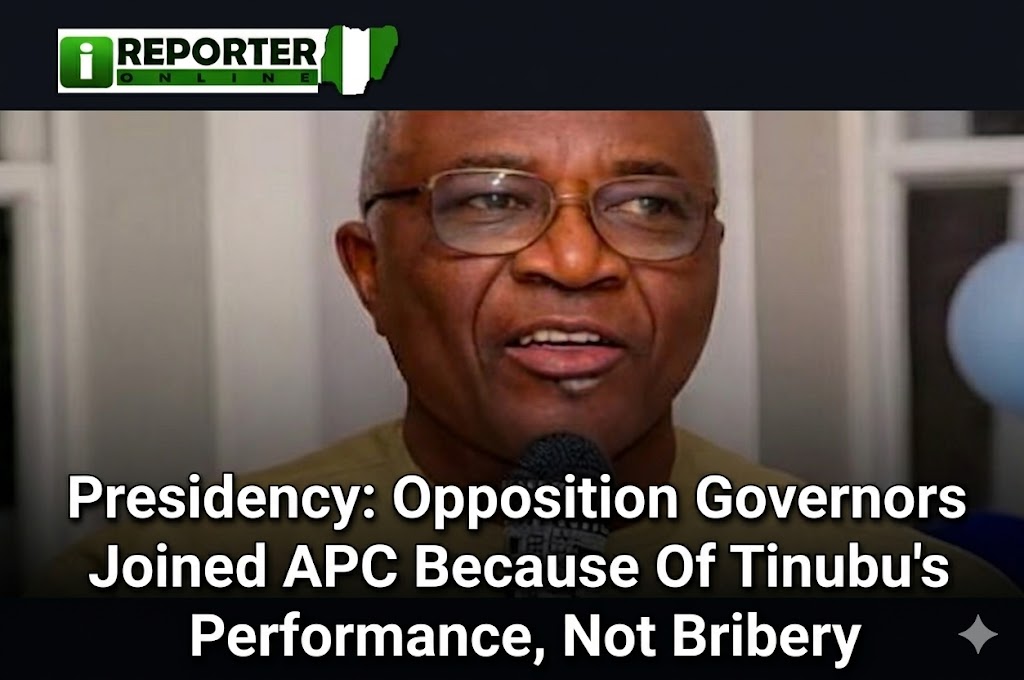
The Presidency has dismissed allegations that opposition governors defecting to the ruling All Progressives Congress (APC) were influenced through inducements, insisting that the wave of defections was driven by the visible impact of President Bola Ahmed Tinubu’s economic reforms and improved financial capacity across states.
According to reports monitored by Ireporter Online, Special Adviser to the President on Information and Strategy, Bayo Onanuga, made the remarks in a detailed opinion piece where he defended the administration’s economic policies and highlighted achievements recorded since President Tinubu assumed office in May 2023.
Onanuga explained that several governors, including those previously aligned with opposition parties, had openly acknowledged that the administration’s fiscal reforms significantly boosted allocations to states and empowered them to execute projects that were once difficult to undertake. He maintained that the governors joined the APC because they had witnessed the positive outcomes of the reforms rather than any form of political bribery.
The presidential aide recalled that before Tinubu’s inauguration, many states struggled to pay salaries and pensions while debt servicing consumed nearly all federal revenue. He stated that the removal of petrol subsidy, exchange rate harmonisation and broader fiscal restructuring transformed the financial standing of states and local governments nationwide.
According to him, the impact of the administration’s policies is more evident at the subnational level, where governors have embarked on large-scale infrastructure and social development projects using increased allocations from the Federation Account.
He cited comments from Kwara State Governor Abdulrahman Abdulrazaq, who reportedly said his administration delivered more projects within the first 18 months of Tinubu’s tenure than it achieved in its earlier four years. Ebonyi State Governor Francis Nwifuru was also said to have credited the reforms for enabling major road and bridge projects in Abakaliki, while Enugu State Governor Peter Mbah reportedly acknowledged that improved federal allocations had supported his ambitious development agenda.
Onanuga further referenced Nasarawa State Governor Abdullahi Sule, who described President Tinubu as a leader willing to make difficult sacrifices to rescue Nigeria’s economy from collapse.
The Presidency noted that the Tinubu administration inherited serious economic challenges, including fuel scarcity, multiple exchange rates, rising inflation, low government revenue and an unsustainable subsidy regime. However, it stated that the President moved quickly after inauguration by removing fuel subsidy, floating the naira, declaring a food emergency and introducing fiscal and tax reforms aimed at modernising the economy.
Although the reforms initially triggered economic hardship and public criticism, Onanuga said the administration remained committed to the policies, insisting that positive outcomes were now emerging across key sectors.
He pointed to the Nigerian stock market as one of the clearest indicators of renewed investor confidence, revealing that the All-Share Index had risen sharply since May 2023 while market capitalisation experienced massive growth. He also noted that several blue-chip companies were posting record profits and attracting renewed interest from foreign investors.
On infrastructure, the Presidency highlighted major projects such as the Lagos-Calabar Coastal Highway, the Sokoto-Badagry Super Highway and multiple rail developments across the country, describing them as some of the most ambitious projects undertaken since independence.
The administration also claimed notable progress in the oil and gas sector through reforms such as the removal of fuel subsidy, the naira-for-crude policy and stricter remittance measures for oil revenues into the Federation Account. According to Onanuga, these policies have strengthened investor confidence and improved energy security.
In the power sector, he said the government was tackling longstanding structural challenges by strengthening the national grid, reviving idle generation companies and addressing legacy debts owed to electricity generation firms and gas suppliers. He added that millions of electricity meters had already been distributed nationwide as part of efforts to improve power supply.
The Presidency also highlighted achievements in education and social intervention programmes, including the Nigerian Education Loan Fund (NELFUND) and CREDICORP. Onanuga disclosed that hundreds of billions of naira had been committed to supporting tertiary education through tuition payments and student stipends benefiting over a million students.
He further stated that the government successfully renegotiated agreements with the Academic Staff Union of Universities (ASUU), leading to uninterrupted academic activities across tertiary institutions, while technical schools and research institutions were also receiving renewed support.
While admitting that insecurity remained a concern, Onanuga said the Federal Government continued to strengthen security agencies with improved equipment, funding and international collaboration involving countries such as the United States, France and the United Kingdom.
He concluded that President Tinubu remained determined to continue implementing difficult but necessary reforms aimed at stabilising the economy, improving governance and securing the future of the country.

-
 Latest News1 day ago
BREAKING: Tinubu Appoints New NIPC, NEPZA Board Chairpersons
-

 Politics3 days ago
Seyi Makinde Makes Big 2027 Move, Names Running Mate
-
 Latest News6 days ago
Zulum Speaks On Gubio’s Running Mate Choice
-
 Latest News7 days ago
New Appointment Announced For Former VP Osinbajo
-
 Latest News2 weeks ago
Uzodimma, Fintiri, Abdurazaq, Other Governors Appear On APC NASS List
-
 Latest News1 week ago
Tinubu Unveils Fresh Appointments For Gbajabiamila, AGF, Others
-
 Politics1 week ago
Key Details Emerge From Meeting Of 18 APC First-Term Governors
-

 Latest News5 days ago
BREAKING: 8 Kidnappers Arrested, Others Eliminated As Oyo Pupils, Teachers Rescued
-
 Politics1 week ago
2027: APC Set To Upload Tinubu, Running Mate This Week
-
 Politics5 days ago
BREAKING: APC Unveils Tinubu’s 2027 Running Mate
-

 Latest News7 days ago
Female Journalist Reportedly Taken Into DSS Custody
-

 Entertainment2 days ago
We Tried” — Diamond Platnumz’s Wife Announces End Of Marriage