


Latest News
Almajiri System: A Rich Educational Legacy

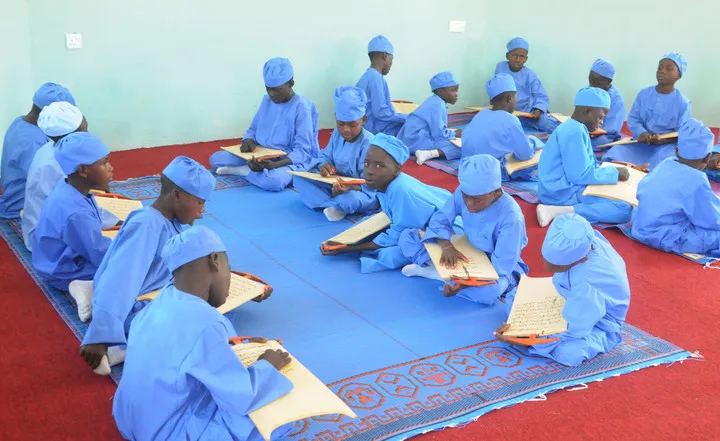
Almajiri System: A Rich Educational Legacy
The Almajiri system, a long-standing educational framework in Northern Nigeria, has long been the subject of debate. In this system, children learn the Qur’an and Islamic principles through teachers known as mallams in Makarantar zaure/allo. Though different from formal schooling…READ MORE…
it remains a form of education where students are engaged in learning, much like in any other system.
However, this system is often misunderstood and criticized, with claims that Almajirai are excluded from education. Rather than dismissing the system as informal or inadequate, it’s important to recognize its role in fostering literacy, moral growth, and religious education. The Almajiri system should not be seen as a failure of the state’s education but as a distinct educational practice that has served communities for centuries.
The Almajiri system, like any educational model, has its shortcomings, including limited resources, overcrowded classrooms, poverty, and exploitation, which have clouded its potential benefits and fueled misconceptions. A common myth is that Almajirai are uneducated simply because their learning curriculum differs from the traditional Western model of education.
Recently, I watched an interview with Professor Suwaiba Said Ahmad, the Minister of State for Education, and I completely agreed with her stance: the Almajirai should not be categorized as “out-of-school.” This viewpoint represents a step toward redefining education in Nigeria and embracing diverse learning models. I have also argued that the Almajiri system requires reform.
After watching the interview, I shared a post on X supporting the Minister’s position, but the response was surprisingly negative. Despite presenting my views clearly in English, I was met with unjustified criticism, with some arguing that since Almajirai cannot speak Arabic fluently, they should not be considered literate.
This argument reflects a misunderstanding of what literacy truly means. Literacy, in its simplest form, is the ability to read and write, regardless of the language. It’s about the ability to decode, understand, and write, not about fluency in spoken language. Almajirai do indeed read and write in Arabic, the language of their Qur’anic education, and many perform impressively. To dismiss their literacy because they do not speak Arabic fluently is an oversimplification.
One can read and write in a language without speaking it. Many scholars study ancient languages, like Latin or Sanskrit, without speaking them. Egyptologists can read hieroglyphs or other ancient languages without speaking them. Similarly, individuals using sign language exhibit literacy and communication without conventional speech. Therefore, literacy is about the ability to read and write, not spoken fluency.
While the Almajiri system faces challenges like overcrowded classrooms, poor living conditions, and exploitation, these issues should not overshadow its merits or mislead the public into thinking that Almajirai are uneducated. The Almajiri system doesn’t need to be compared to traditional education systems. It’s not about being identical to conventional schooling but about thoughtful reform that integrates modern subjects and standardizes quality.
Reforming the system through standardization would ensure consistent quality across schools, while integrating subjects like mathematics, science, and vocational skills would prepare students to face contemporary challenges. This reform would not strip the Almajiri system of its religious and cultural identity but would equip students to succeed in the global economy while preserving their heritage. Such reform would benefit not only the Almajiri but also Nigerian society by ensuring that all children receive an education that prepares them for the future.
The Minister’s statement, alongside the growing discourse on Almajiri education, represents a significant step forward in Nigerian education. By acknowledging the Almajiri system as a legitimate form of education, we move closer to an inclusive framework that respects cultural diversity. Reforming the system to include modern subjects and improve infrastructure will ensure its continued relevance.
With effective reform and open dialogue, the Almajiri system can continue to contribute to Northern Nigeria’s educational and cultural landscape. It’s time to recognize its history, address its shortcomings, and embrace it as part of Nigeria’s educational heritage. Unfortunately, many criticize the system instead of supporting reform efforts, which undermines the goal of creating an inclusive and equitable education system in Nigeria.
As we move forward, let us prioritize meaningful dialogue based on understanding and respect, rather than division and misconceptions.
For More Information And News Update, Join Ireporteronline WhatsApp Channel With Link Below: https://whatsapp.com/channel/0029VaV4jB6DuMRgwqnJCF32 For advertisement inquiries only, kindly send a message to 09010649814 on Whatsapp

-
 Latest News14 hours ago
BREAKING: Tinubu Appoints New NIPC, NEPZA Board Chairpersons
-

 Politics2 days ago
Seyi Makinde Makes Big 2027 Move, Names Running Mate
-

 Latest News5 days ago
Zulum Speaks On Gubio’s Running Mate Choice
-

 Latest News6 days ago
New Appointment Announced For Former VP Osinbajo
-

 Latest News2 weeks ago
Uzodimma, Fintiri, Abdurazaq, Other Governors Appear On APC NASS List
-

 Latest News7 days ago
Tinubu Unveils Fresh Appointments For Gbajabiamila, AGF, Others
-

 Politics1 week ago
Key Details Emerge From Meeting Of 18 APC First-Term Governors
-

 Latest News2 weeks ago
After Billions Spent, Bridge Still Abandoned: Citizens Issue Open Letter to Tinubu, Works Minister, Osun Governor, National Assembly Over ÒRÉ Bridge
-

 Latest News4 days ago
BREAKING: 8 Kidnappers Arrested, Others Eliminated As Oyo Pupils, Teachers Rescued
-

 Politics1 week ago
2027: APC Set To Upload Tinubu, Running Mate This Week
-

 Politics4 days ago
BREAKING: APC Unveils Tinubu’s 2027 Running Mate
-

 Latest News6 days ago
Female Journalist Reportedly Taken Into DSS Custody