


Latest News
How A 3.2-Million-Year-Old Human Relative Named Lucy Walked

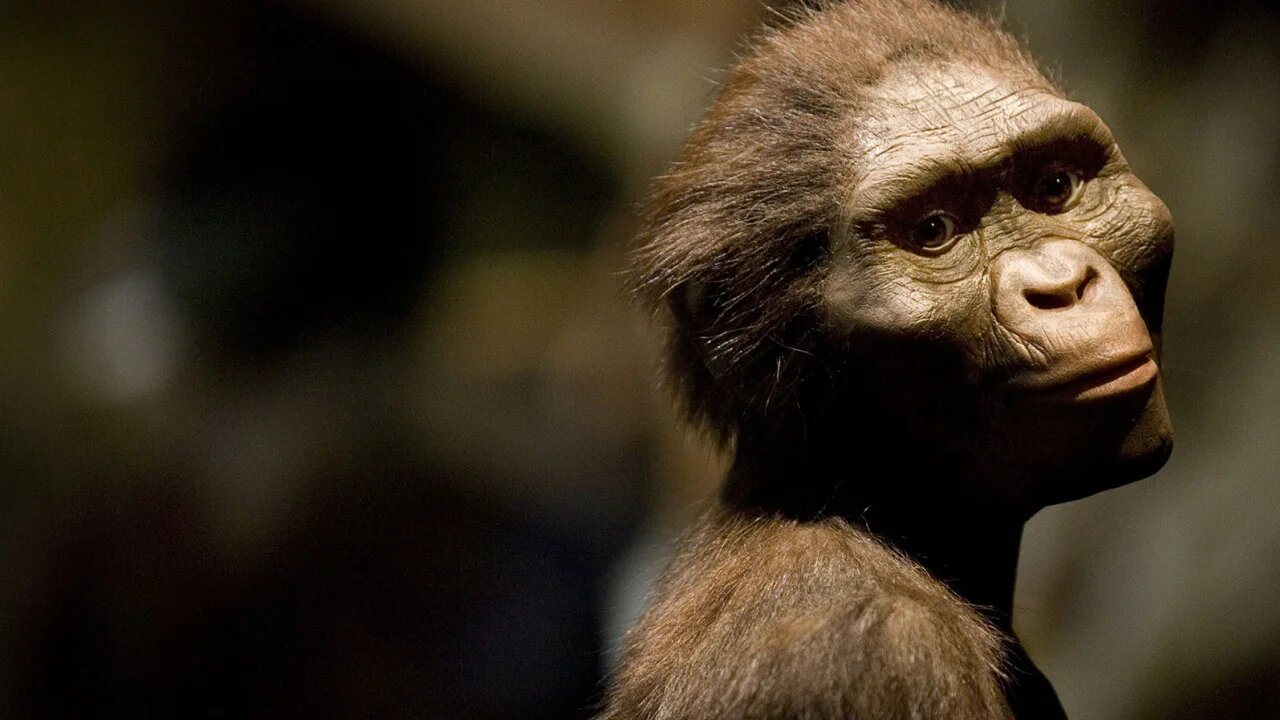
How A 3.2-Million-Year-Old Human Relative Named Lucy Walked
When the remains of an early human ancestor were found in Ethiopia in 1974, the discovery provided an unprecedented look at a species that lived millions of years before humans walked the Earth.
The rare fossil, representing 40% of a skeleton belonging to a female Australopithecus afarensis, was named “Lucy,” for the Beatles song “Lucy in the Sky With Diamonds.”
Now, researchers are using the skeleton to figure out how this ancient human relative moved 3.2 million years ago. The findings of the study were published Tuesday in the journal Royal Society Open Science.
Lucy was shorter than the average human, reaching about 3.3 feet (1 meter) in height, had an ape-like face and a brain about one-third the size of a human brain.
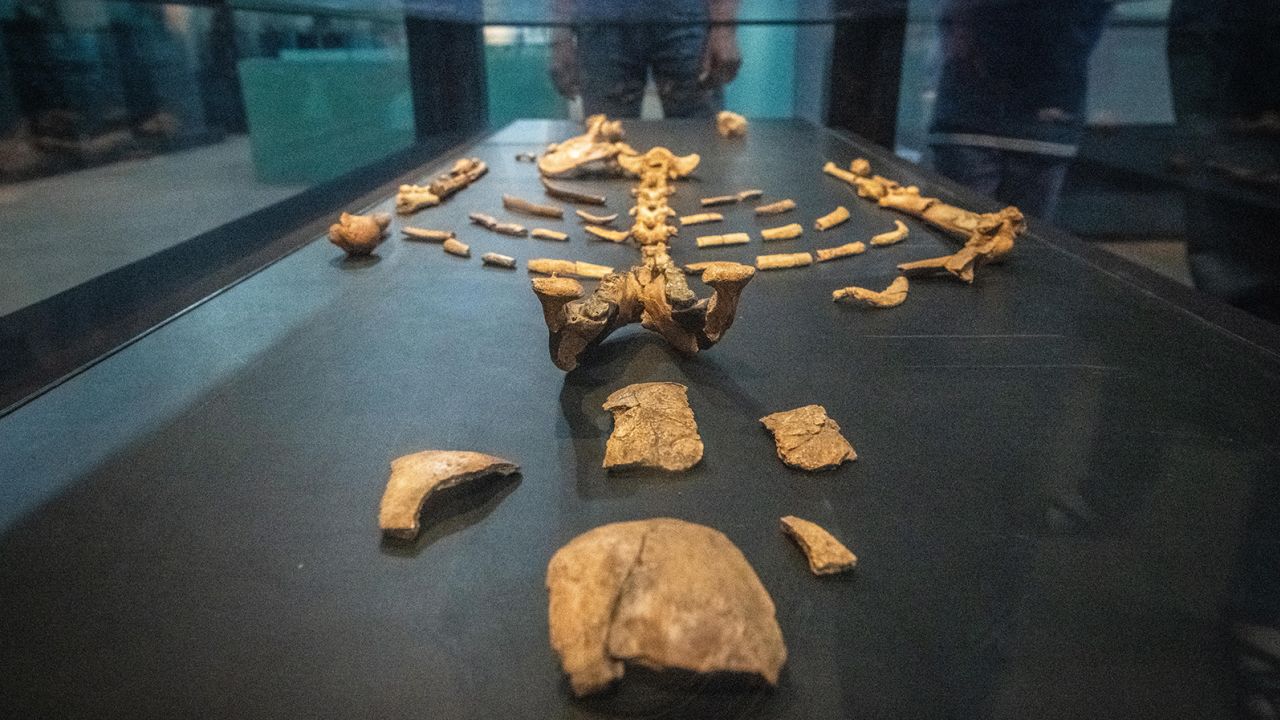
Lucy’s fossil includes 40% of her skeleton, one of the most complete Australopith fossils found to date. Edwin Remsberg/Alamy Stock Photo
Analysis of Lucy’s fossil over the past 20 years has suggested that she and others of her species walked upright. But lead study author Dr. Ashleigh L.A. Wiseman, a research associate at the University of Cambridge in the United Kingdom, wanted to take things a step further and recreate a component of Lucy that didn’t fossilize: her muscles.
Read Also Breast Is Life – Man Captured Playing With Lady’s B00bs As He Makes Declaration (VIDEO)
“The defining aspect of what makes us human is the ability to walk on two legs, but understanding how and why this evolved has been debated for a long time,” said Wiseman, who is the Leverhulme Trust Early Career Fellow and Isaac Newton Trust Fellow at the McDonald Institute for Archaeological Research.
“With recent advances in computational modeling, it is now possible to investigate these questions. Of course, in the fossil record we are left looking at the bare bones. But muscles animate the body — they allow you to walk, run, jump and even dance. So, if we want to understand how our ancestors moved, we first need to reconstruct their soft tissues.”
Studying fossils of Australopithecus afarensis can provide insight into the evolution of bipedalism, or walking upright, and when it emerged in early human ancestors. Wiseman’s reconstructions of Lucy’s muscles could also be used to determine how Lucy moved in other ways.
Rebuilding Lucy’s muscles
Wiseman and her colleagues developed a method called polygonal muscle modeling and initially used it to reconstruct the missing soft tissues of extinct reptiles called archosaurs that lived 247 million years ago.
Then, Wiseman applied to same method to Lucy for the first time to understand the shape and size of her muscles and how she used them to move, assessing whether it was like the crouched waddle of an upright chimpanzee or the stance of a human.
Wiseman used scans of Lucy’s fossil and data from humans to build a three dimensional model of the leg and pelvis muscles of Australopithecus afarensis. After collecting data from MRI and CT scans of muscle and bone structures in modern humans, the researcher digitally created a musculoskeletal model.
Then, she used scans of Lucy’s fossil to determine how her joints were articulated and moved in life. Wiseman layered in 36 muscles in each leg using the “muscle map” from the modern human data, combined with “muscle scarring,” or the discernible traces of muscle connection that are detectable in fossils.
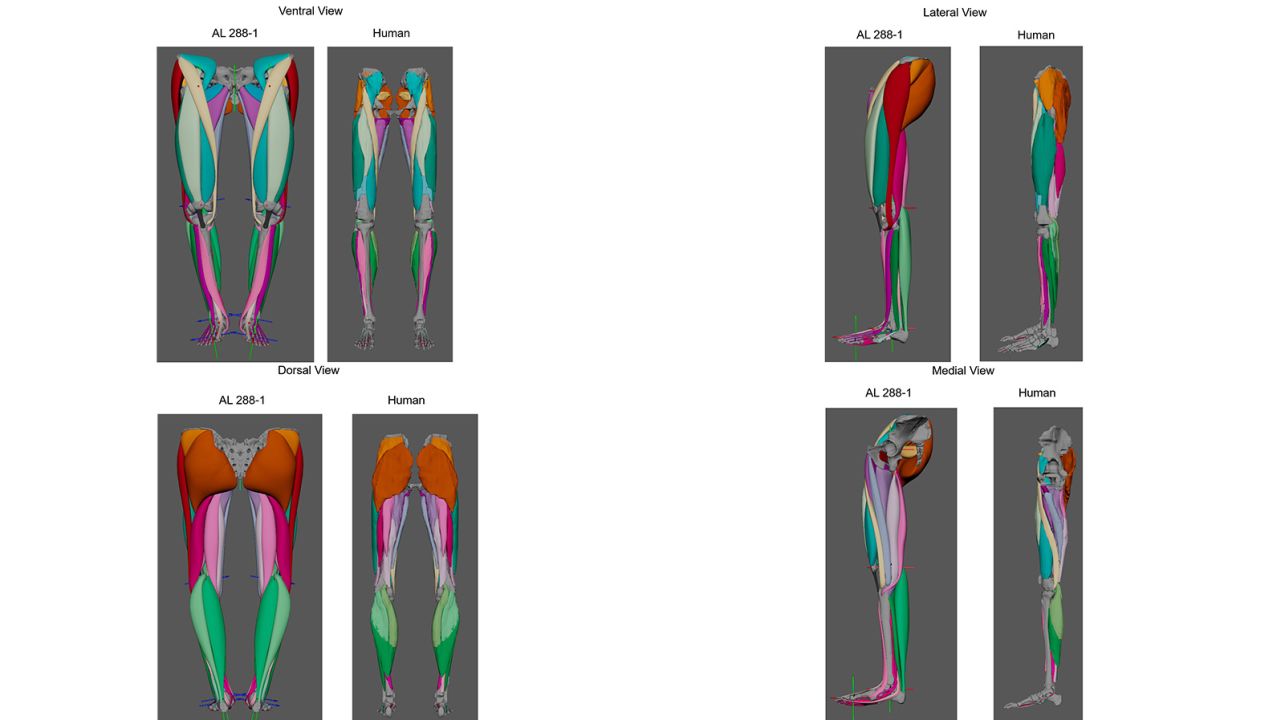
Muscle modeling of Lucy, dubbed “AL 288-1,” is compared side by side with human muscle maps. Dr Ashleigh Wiseman/University of Cambridge
Lucy’s skeleton differs from humans because she had shorter legs and a more platelike pelvis (when viewed from the top down).
Wiseman’s model showed that while a modern human’s thigh was about 50% muscle mass, with the rest attributed to fat and bone, Lucy’s thigh would have been nearly 75% muscle. Overall, Lucy’s leg muscles were much larger and took up more space than those of modern humans.
“Lucy lived 3.2 million years ago on the African savannah. She would need to have walked over uneven ground and explored a mixture of forested environments and open grassland,” Wiseman said.
“Larger muscle mass typically means greater muscle force, and it is very unsurprising to find that the reconstructions of Lucy’s muscles demonstrates that she had greater muscle mass than a human, enabling her to move freely between these different environments.”
Standing upright
Paleoanthropologists have wondered about Lucy’s posture because her skeleton differs from modern humans.
Humans have a stable stance with fully straightened legs, but when chimpanzees stand upright, they can’t straighten their legs. They walk with a crouched posture due to their bent hips and knees, which is why chimps largely walk on all fours.
The 3D model showed that the leverage of Lucy’s knee extensor muscles meant that she could stand erect like modern humans.
“I was very surprised to find that the knee extensors (those muscles that produce and maintain a straight knee when you stand upright) were so comparable to the human,” Wiseman said. “This means that Lucy could stand and likely walk as efficiently as we can.”
Australopiths such as Lucy lived in an environment that included both open grasslands and dense forests, and had bodies adapted to thrive both on the ground and in trees.
“Lucy likely walked and moved in a way that we do not see in any living species today,” Wiseman said.
“If Lucy was a biped just like we are and walked exclusively on two legs, then she should be able to move in similar ways as we can,” Wiseman said.
Credit: CNN

-

 Politics1 day ago
Tinubu Makes Fresh Appointment
-

 Politics2 weeks ago
BREAKING: Tinubu Inaugurates New Ministers
-

 Latest News2 weeks ago
INEC Drops Final List Of Candidates For June 2026 Bye-Elections
-

 Latest News1 week ago
Abubakar Momoh Engages CCECC President At Global Infrastructure Forum In China
-

 Politics6 days ago
APC Rules Out Any Review Of 2027 Primary Election Results
-

 Politics2 days ago
36 Governors Reveal Their Stance On State Police
-

 Latest News6 days ago
Obasanjo Teases Abdulsalami: “I And Gowon May Not Be Alive When You Hit 100
-

 Latest News4 days ago
You Can’t Sign Chequebooks!’ — Wike Issues Tough Warning To FCT Area Council Chairmen
-
 Latest News7 days ago
Kidnap Suspects Reveal How They Abducted Adelabu’s Sister And Twin Sons
-

 Entertainment2 days ago
Dayo Amusa Blasts Peter Obi: “You Can’t Criticize Government And Hide Your Plans
-

 Latest News5 days ago
Benin Market Kidnapping: Okpebholo Orders Full Investigation
-

 Latest News1 week ago
No One Is Interested!’ – Aisha Yesufu Blasts NDC National Leader, Senator Dickson