

Latest News
Cooking Gas Crisis Deepens: Why Prices Will Stay High Across Nigeria

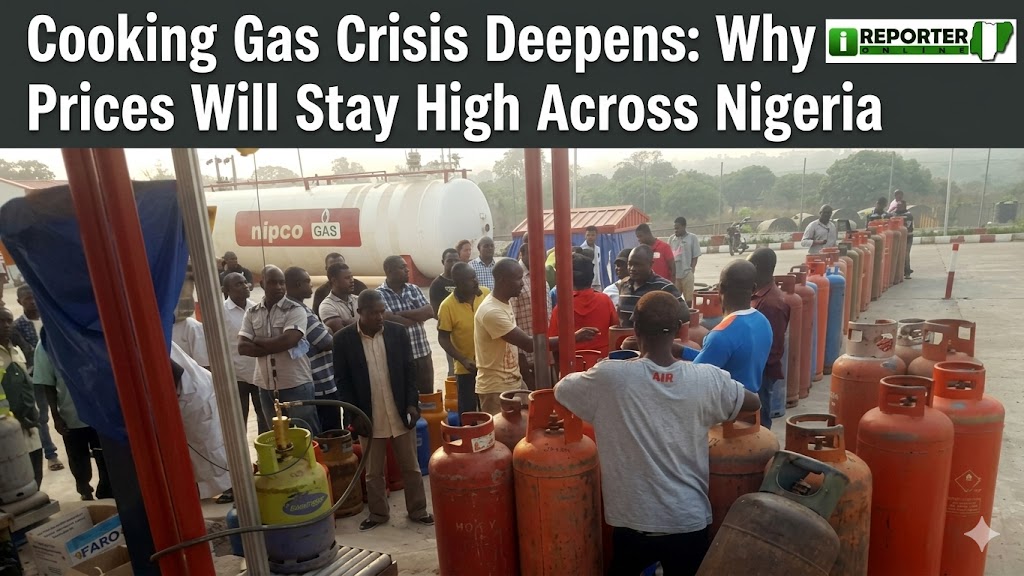
Despite being endowed with Africa’s largest proven gas reserves and recording a steady rise in production, Nigeria is currently grappling with an escalating shortage of Liquefied Petroleum Gas (LPG), commonly used as cooking gas.
According to Ireporter Online, findings reveal that the supply squeeze has continued to drive up retail prices while intensifying hardship for households and small businesses nationwide.
Data obtained from the Nigerian Upstream Petroleum Regulatory Commission showed that about 62 per cent of Nigeria’s gas output in the first two months of the year was exported, leaving only 38 per cent for domestic consumption. Industry analysts argue that this imbalance reflects a supply framework designed for a much lower level of local demand and is now increasingly unable to meet current consumption needs.
An industry report titled Nigeria LPG Production & Supply Matrix (2023–2026) indicated that national LPG consumption rose by 20 per cent to 1.8 million metric tonnes in 2026, up from 1.5 million metric tonnes in 2023. However, total supply is estimated between 1.55 million and 1.65 million metric tonnes, creating a persistent supply gap.
Although domestic production has improved with contributions from facilities such as the Dangote Refinery, Nigeria LNG, and other gas processing plants, the output remains insufficient to bridge the widening demand gap.
The shortage has triggered a sharp rise in retail prices across the country, with LPG now selling between ₦1,700 and ₦2,000 per kilogramme in many locations, compared to an average of about ₦1,100 earlier in the year. Industry operators warn that prices may continue to rise if structural inefficiencies are not addressed.
Experts attribute the crisis to several factors, including inadequate gas infrastructure, export prioritisation, insecurity, pipeline vandalism, limited storage capacity, and regulatory bottlenecks. An industry stakeholder who spoke anonymously noted that Nigeria lacks sufficient pipelines, storage facilities, and processing infrastructure to efficiently distribute gas from production sites to consumers. He also explained that producers often favour export markets due to higher returns and more stable foreign exchange earnings.
The Nigerian Association of Liquefied Petroleum Gas Marketers has expressed concern over the growing burden on citizens. Its National President, Edu Inyang, alongside Executive Secretary Bassey Essien, said rising depot prices and supply shortages have made cooking gas increasingly unaffordable, warning that many households are being pushed back to firewood and charcoal.
Industry leaders, including the National President of the Oil and Gas Service Providers Association of Nigeria, Colman Obasi, cautioned that infrastructure gaps, insecurity, foreign exchange volatility, and regulatory challenges would take years to resolve, stressing that Nigeria may continue to face shortages despite its vast reserves unless major investments are made in gas processing and distribution.
Data from the National Bureau of Statistics further revealed that cooking gas prices have surged by about 335 per cent over the past decade, rising from ₦400 per kilogramme in 2016 to approximately ₦1,741 in 2026, underscoring the long-term impact of supply constraints and economic pressures.

-

 Latest News4 days ago
Tinubu Announces New Appointment, Sends Nominee To Senate For Confirmation
-

 Latest News2 weeks ago
Presidency Moves Against VDM Over Fake Tinubu Audio Allegation
-
 Latest News7 days ago
Shake-Up At CBN: Deputy Governors Redeployed, Full List Released
-

 Politics2 weeks ago
Wike’s PDP Camp Unveils 2027 Presidential Candidate
-

 Politics6 days ago
June 12: Tinubu Set For Nationwide Broadcast, NASS Address
-
 Politics4 days ago
Wike Clears Air On Chinda, Says INEC Candidate List Drops In July
-

 Politics2 weeks ago
APC Drops Full List Of Lagos Assembly, Reps Candidates For 2027 Elections
-

 Education1 week ago
NELFUND Refutes Claims Of Suspending Students’ Upkeep Allowance
-

 Politics1 week ago
Ganduje Fires At Kwankwaso: “He Was Once My Political Boy
-

 Latest News2 weeks ago
Jibrin Breaks Silence On Dumping Kwankwaso For Tinubu: “It Wasn’t Betrayal
-

 Politics1 week ago
2027: Kwankwaso Breaks Silence After Being Named Peter Obi’s Running Mate
-
 Latest News4 days ago
Police Provide Fresh Update On Release Of Abducted Oyo Pupils, Teachers