

Economy
Drama Between NNPCL And Dangote Refinery Damaging Economic Growth – Muda Yusuf


Drama Between NNPCL And Dangote Refinery Damaging Economic Growth – Muda Yusuf
An economist, Muda Yusuf has stated that the dramatization of petrol prices between Dangote Refinery and the Nigerian National Petroleum Company Limited (NNPCL) is worrisome.
Yusuf argued that the development would scare away investors.
He shared his reservation during an appearance on Channels Television’s The Morning Brief.
“I’m worried about the dramatisation of the cost the NNPCL is buying from Dangote. Coming to the public space to exchange the things we’re hearing. I don’t think it’s good for the economy, it’s not good for our perception and it’s not good for investors’ confidence,” Yusuf said.
Speaking further, the economist asserted that it is impossible for Nigeria to walk away from the issue of petrol subsidy removal due to the low social safety net for the poor and vulnerable in the country.
He noted that even after the presidential statement on May 29, 2023, that the subsidy is gone, the NNPCL admitted to shouldering cost differentials with imported petroleum products.
He said, “We cannot walk away so quickly from this problem of subsidy otherwise it would make life extremely difficult. Things are already very difficult.
“Up until now the NNPCL was subsidising although progressively the level of subsidy is being reduced which is fine, but to talk of a complete deregulation of the whole system in an economy without a social safety net will not be appropriate at all.”
He stated that the citizens are economically overstretched, adding that the hike in the pump prices of petrol has made the situation worse.
“The economy is about human beings and we need to recognise that because we are driving the citizens almost to their limits,” the economist added.
According to him, total deregulation is not possible in a country like Nigeria which doesn’t have a safety net for the citizens to fall back on.
The economist proposed that the government reduce the demand for imported products through import substitution across all sectors of the economy.
“If we’re able to move that pressure away, it will have a significant impact on the exchange rate. If progressively we can look inward and reduce import we’ll be making progress,” he added.

-

 Politics2 weeks ago
Tinubu Makes Fresh Appointment
-
 Latest News4 days ago
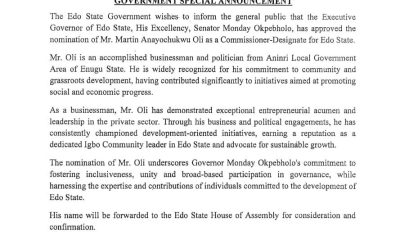
Breaking Political Barriers: Okpebholo Names Enugu-born Igbo Leader to Edo Cabinet
-

 Politics6 days ago
Tinubu Makes New Ambassadorial Appointments, Seeks Senate Confirmation
-

 Latest News1 week ago
Breaking: Okpebholo Backs Words With Action As Edo Moves To Establish Special Court For Cultism And Kidnapping Cases, Writes Chief Judge
-

 Latest News7 days ago
Ojirami Shines at Night: Akoko-Edo Residents Hail Engr. Abubakar Momoh Over NDDC Solar Street Light Project
-

 Latest News1 week ago
Bandits’ Captivity Death: Widow Rejects Illness Claims, Reveals What K!lled General Rabe
-

 Politics2 weeks ago
36 Governors Reveal Their Stance On State Police
-

 Sports3 days ago
Full List: Every Team Eliminated From The 2026 World Cup So Far
-

 Latest News5 hours ago
APC Submits National Assembly Candidates’ Names To INEC Portal
-

 Politics1 week ago
VIDEO: Shettima, Atiku, Masari, Governors Storm Special Prayer For Tinubu’s Late Mother
-

 Latest News1 day ago
APC Dismisses Viral List Of Primary Election Winners
-

 Entertainment2 weeks ago
Dayo Amusa Blasts Peter Obi: “You Can’t Criticize Government And Hide Your Plans