

Latest News
PFIPC Scandal: ICPC Uncovers How ‘Fake’ Agency Entered Nigeria’s Federal Budget

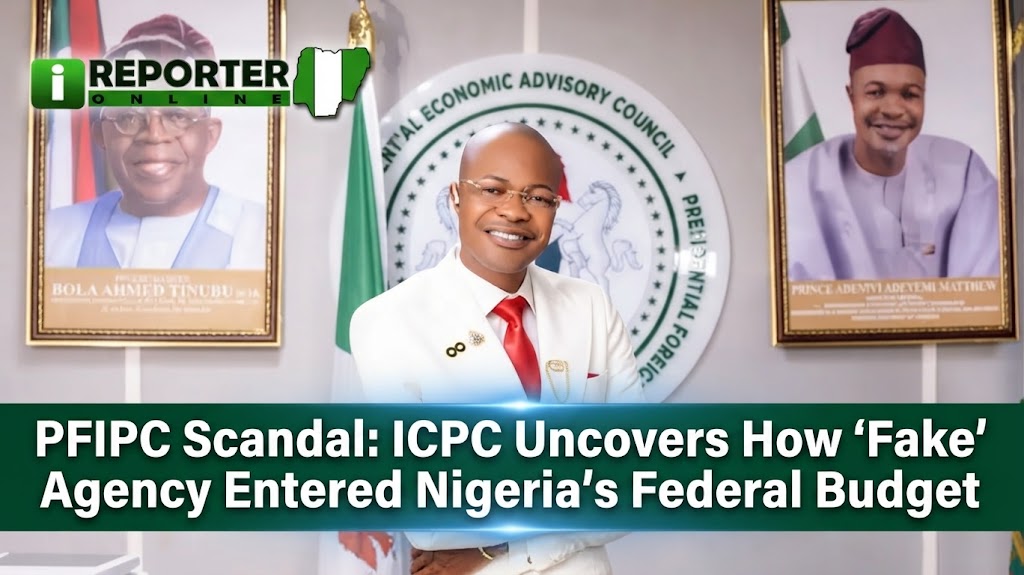
The Independent Corrupt Practices and Other Related Offences Commission (ICPC) has identified significant lapses within the Budget Office of the Federation (BOF) that enabled the purported Presidential Foreign Intervention Promotion Council (PFIPC), led by Adeyemi Adeniyi, to be included in Nigeria’s 2026 federal budget.
According to Ireporter Online, the findings were contained in an ICPC investigation into the activities of the organisation and the processes through which it was admitted into the federal budget.
The anti-corruption commission found that the Budget Office processed and onboarded the purported agency despite gaps in its documentation and without independently verifying the legal instrument establishing it.
Investigators said the BOF relied mainly on an administrative code issued by the Office of the Accountant-General of the Federation (OAGF), alongside establishment documents attributed to the Office of the Head of the Civil Service of the Federation (OHCSF).
The ICPC noted that the process for onboarding a new government institution into the national budget requires an administrative or accounting code from the OAGF, as well as an authorised establishment and recruitment waiver from the OHCSF.
According to the investigation, the Budget Office received a letter from the OAGF on November 29, 2024, conveying Administrative Code 0111062001 for the purported PFIPC. However, there was no direct official communication from the OHCSF transmitting the authorised establishment and recruitment waiver. Instead, the document available to the Budget Office was a scanned copy.
The investigation further revealed that a budget proposal submitted on behalf of the PFIPC on August 20, 2025, initially requested N3.85 billion for personnel expenditure. However, the Budget Office did not approve the proposed amount because the organisation had not provided an approved salary structure from the National Salaries, Incomes and Wages Commission.
The BOF subsequently recalculated the figures using the Consolidated Public Service Salary Structure, arriving at an allocation of about N1.3 billion. The amount consisted of N802 million for personnel, N200 million for overhead and N300 million for capital expenditure.
The ICPC said the purported council had not submitted estimates for overhead and capital expenditure, forcing the Budget Office to determine those figures using its assessment of the proposed personnel structure, comparable government agencies, the council’s functions, size and age.
Despite the incomplete documentation, the Budget Office proceeded with the onboarding process.
The commission said the office relied on informal engagements and unverified scanned approvals without evidence that the outstanding deficiencies were formally communicated to or resolved by the relevant authorities.
The investigation, however, found that although a budgetary provision was made for the purported agency, there was no evidence establishing that the funds were eventually released, cash-backed, paid or spent.
The ICPC concluded that the Budget Office failed to conduct sufficient due diligence to establish the legal status of the purported PFIPC before allowing it into the federal budget.
It also found no evidence that the BOF independently verified the organisation’s establishment instrument, enabling authority, supervisory authority or presidential approval before processing its budget proposal.
The commission further identified weaknesses in the Budget Office’s internal control mechanisms, noting that existing procedures requiring officers to examine the completeness and integrity of budget submissions were not effectively applied in the case.
Investigators also discovered that the budget manager who handled the PFIPC proposal had not seen or used the Expenditure Department’s Standard Operating Procedure, raising concerns about how effectively the department’s guidelines had been institutionalised.
The ICPC said the absence of a specific requirement for independent verification of key governance documents before admitting newly established agencies into the federal budget created a major control gap.
It consequently recommended stronger onboarding requirements, including making complete establishment documents and other mandatory budget records prerequisites for the inclusion of new government institutions in the national budget.
The commission maintained that the identified weaknesses extended beyond the PFIPC case and exposed vulnerabilities in the broader federal budget onboarding system.
Meanwhile, Adeyemi Adeniyi, who has been identified as the purported chairman of the organisation, has maintained his innocence and said he would establish his case through the appropriate legal process.

-

 Latest News6 days ago
Tinubu Govt Declares Nationwide Public Holiday For Nigerians
-

 Entertainment4 days ago
₦800,000, ₦5m, $11,000: Ogogo’s Daughter Accuses Nigerians Of Exploiting Father’s Cancer
-

 Latest News1 week ago
Tinubu Meets Akpabio, Doguwa, Oyetola, Alake At Aso Rock
-

 Latest News2 weeks ago
INEC Makes Fresh Announcement After Declaring Adeleke Winner Of Osun Election
-

 Latest News5 days ago
APC Chairman Collapses, D!es
-

 Latest News3 days ago
Uzodinma Won’t Market Tinubu To Igbos’ – Oshiomhole Reveals Who Should Help
-
 Latest News4 days ago
Tinubu Renews Appointments In NTA, NAN
-

 Latest News2 days ago
FG Announces New Appointment
-

 Gist2 weeks ago
Your Uncle Adeleke Is The Real Arindin’ – Sowore Fires Back At Davido
-

 Entertainment1 week ago
Ogogo’s Family Breaks Silence, Debunks Viral D**th Rumour
-

 Latest News2 days ago
Tinubu Reviews APC Campaign Council Over ‘Corrupt’ Names — See Who Escaped the Shake-Up
-

 Latest News2 weeks ago
Osun Election: INEC Gives Fresh Update As Voting Continues