

Latest News
Supreme Court Reserves Judgment In INEC, Electoral Act Dispute

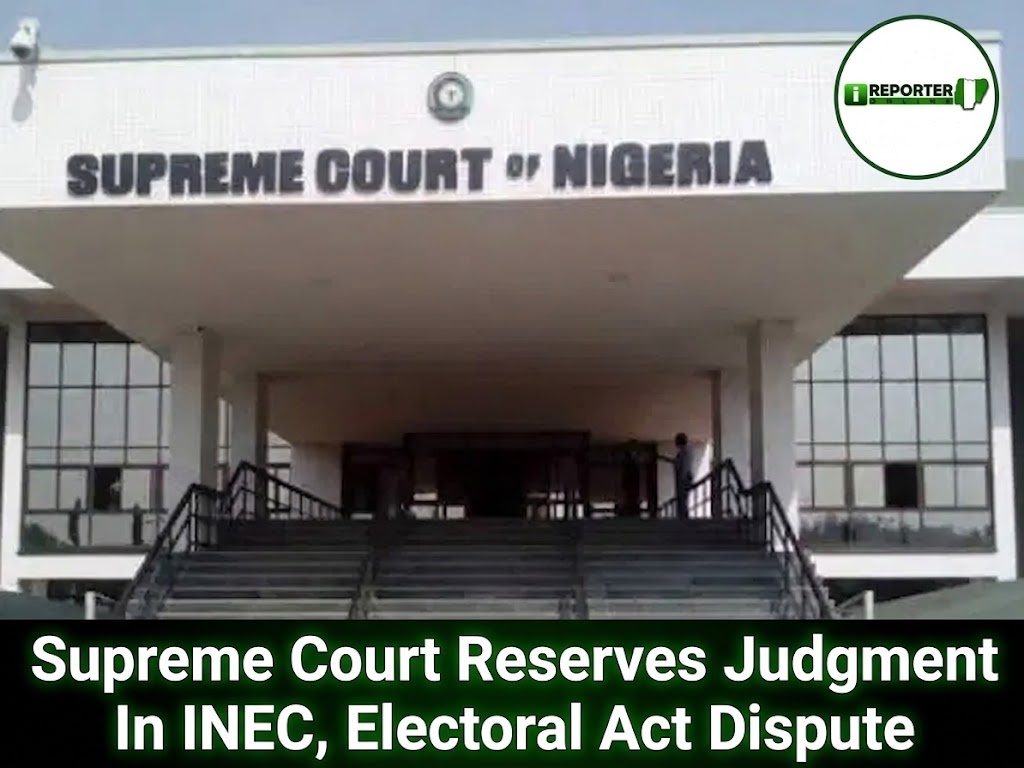
The Supreme Court has reserved judgment in an appeal filed by the Independent National Electoral Commission (INEC) challenging a Court of Appeal decision that nullified four provisions of the Electoral Act 2026.
According to reports, a seven-member panel of the apex court, led by Justice Adamu Jauro, reserved judgment on Wednesday after hearing arguments from the parties in the case.
The disputed provisions are Sections 77(5), 77(6), 77(7) and 84(2) of the Electoral Act 2026. They concern political party membership registers and the procedures parties may adopt when selecting candidates for elections.
INEC, represented by Dr Alex Izinyon, SAN, is challenging the Court of Appeal’s decision, while the Zenith Labour Party (ZLP), represented by Ikechukwu Anyalewechhi, is the respondent.
The dispute originated from a suit filed by the ZLP at the Federal High Court in Abuja, where the party challenged the constitutionality of the disputed provisions. The party argued that the provisions interfered with the constitutional powers of political parties to manage their internal affairs, including membership and candidate selection.
The Federal High Court, presided over by Justice Mohammed Umar, dismissed the suit on May 5, 2026. Dissatisfied with the ruling, the party appealed to the Abuja Division of the Court of Appeal.
On July 16, 2026, the Court of Appeal allowed the appeal in part and declared Sections 77(5), 77(6), 77(7) and 84(2) unconstitutional. The appellate court held that the provisions were inconsistent with constitutional provisions concerning the powers and internal affairs of political parties.
Section 77(5) concerns eligibility to participate in party primaries, congresses and conventions based on names contained in membership registers submitted to INEC. Section 77(6) restricts parties from using a membership register other than the one submitted to the electoral commission, while Section 77(7) provides consequences for parties that fail to submit their registers within the prescribed period.
Section 84(2), meanwhile, provides for direct primaries or consensus as methods of nominating candidates for elective positions.
The Court of Appeal held that the disputed provisions went beyond the constitutional framework governing political parties and their internal affairs. However, the court clarified that its decision did not invalidate the entirety of Sections 77 and 84, with provisions requiring parties to maintain membership registers remaining in effect.
The Supreme Court is now expected to determine whether the Court of Appeal was correct in nullifying the disputed provisions or whether the requirements contained in the Electoral Act 2026 should remain operative.
The final judgment is expected to provide clarity on the legal framework governing party membership registers and candidate nomination procedures under the 2026 Electoral Act.

-

 Latest News2 weeks ago
Tinubu Shelves UNGA Trip, Shettima To Lead Nigerian Delegation
-

 Entertainment1 week ago
Nollywood Actress, Nimmy Ferrari Buried In Newly Built House
-

 Latest News2 weeks ago
NDC Rejects INEC List: ‘We Did Not Submit The Names Published
-

 Latest News2 weeks ago
ICPC Sacks Officer After Sneaking El-Rufai’s Wife Into Facility
-

 Latest News1 day ago
BREAKING: Akpabio, Oshiomhole, Uzodimma, 1,300 Others Named In INEC List
-

 Latest News2 weeks ago
After 12 Years, Uber Pulls Out Of Nigeria — Full Details Emerge
-

 Latest News2 days ago
2027 Politics: Two Lawmakers Defect To APP
-

 Latest News1 week ago
Kano: Only Opposition Senator Dumps Party For APC With 136,000 Supporters
-

 Latest News1 week ago
15 Northern States Will Collapse Within 3 Months” — Ogunyemi Hits Atiku Over Subsidy Promise
-

 Latest News2 weeks ago
Human Trafficking: NSCDC Rescues 15 Minors Allegedly Sold For ₦2m Each
-

 Latest News1 day ago
Tinubu Sends Strong Warning To Regional Commissions: ‘No More Wasting Funds’
-

 Latest News1 week ago
Student Loan Demand Overwhelming — NELFUND Raises Alarm