
Latest News
BREAKING: Amid Tinubu’s Certificate Controversy Another Fresh Revelation Made On President That Will Surprise Nigerians


BREAKING: Amid Tinubu’s Certificate Controversy Another Fresh Revelation Made On President That Will Surprise Nigerians
Festus Osifo, the National President of the Petroleum and Natural Gas Senior Staff Association of Nigeria (PENGASSAN), has stated that the Federal Government continues to subsidize petroleum.
Despite President Bola Tinubu’s declaration during his inauguration that the subsidy era had ended, leading to an increase in the commodity’s cost nationwide, Osifo, who also serves as the president of the Trade Union Congress (TUC), explained that due to the expense of crude oil in the global market and the exchange rate between the dollar and the naira, the government is still providing a subsidy for the product.
Read Also BREAKING: Fresh Revelations As Tinubu’s Lawyer Speaks On Outcome Of CSU Deposition At US Court
“They [government] are paying subsidy today,” he said on Channels Television’s Politics Today on Friday.
“In reality today, there is subsidy because as of when the earlier price was determined, the price of crude in the international market was somewhere around $80 for a barrel. But today, it has moved to about $93/94 per barrel for Brent crude. So, because it has moved, then the price [of petroleum] also needed to move,” the PENGASSAN boss added.
For the government to stop subsidising petroleum, he said two things must happen.
“The only reason the price will not move is when you are able to manage your exchange rate effectively and you are able to pump in supply and bring down the exchange rate,” Osifo maintained.
“So, if the exchange rate comes down today, we will not be paying subsidy. But with the exchange rate value and the price of crude oil in the international market, we have introduced subsidy.”
For decades, the fuel subsidy had artificially maintained low petrol prices, which many Nigerians viewed as a government-provided benefit. Nevertheless, this practice incurred significant annual costs for the country. Despite being a major petroleum producer, Nigeria heavily relies on fuel imports due to its limited refinery capacity.
President Tinubu acknowledged the difficulties faced by Nigerians after the removal of the subsidy and in July, introduced measures to alleviate its impacts.
To “reduce the burden”, he pledged at least $264 million for agriculture, $165 million for small and medium-sized businesses, and $99 million for manufacturing.
“In the short and immediate terms, we will ensure staple foods are available and affordable,” he said.
“To this end, I have ordered the release of 200,000 metric tonnes of grains from strategic reserves to households,” Tinubu added.
Never Miss Any News, Join Our WhatsApp Group With This Link Below

-

 Entertainment2 weeks ago
₦800,000, ₦5m, $11,000: Ogogo’s Daughter Accuses Nigerians Of Exploiting Father’s Cancer
-
 Latest News2 weeks ago
Uzodinma Won’t Market Tinubu To Igbos’ – Oshiomhole Reveals Who Should Help
-
 Latest News2 weeks ago
APC Chairman Collapses, D!es
-
 Latest News2 weeks ago
Tinubu Renews Appointments In NTA, NAN
-

 Latest News2 weeks ago
FG Announces New Appointment
-
 Latest News2 weeks ago
Tinubu Reviews APC Campaign Council Over ‘Corrupt’ Names — See Who Escaped the Shake-Up
-
 Entertainment2 weeks ago
‘Please Forgive Me’ – Ijebu Begs Colleagues After Ogogo’s D**th
-
 Latest News1 week ago
Malami Sends Strong Message To ADC Members Ahead Of 2027 Elections
-

 Latest News2 weeks ago
Full List: Meet Members Of New Fake Agency Uncovered By ICPC
-
 Latest News3 days ago
BREAKING: FG Makes Fresh Appointment
-

 Latest News2 weeks ago
TINUBU UNLEASHES 2027 CAMPAIGN MACHINE: YARI TAKES COMMAND, UZODIMMA GETS KEY ROLE, OSHIOMHOLE TO LEAD MOBILISATION
-
 Business4 days ago
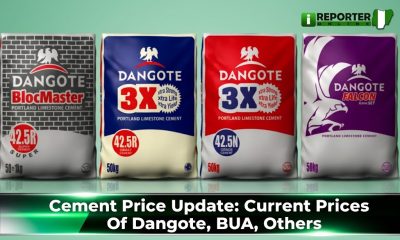
Cement Price Update: Current Prices Of Dangote, BUA, Others