
Latest News
EFCC Makes Massive ₦1.23tn Recovery, Gets 10,872 Convictions

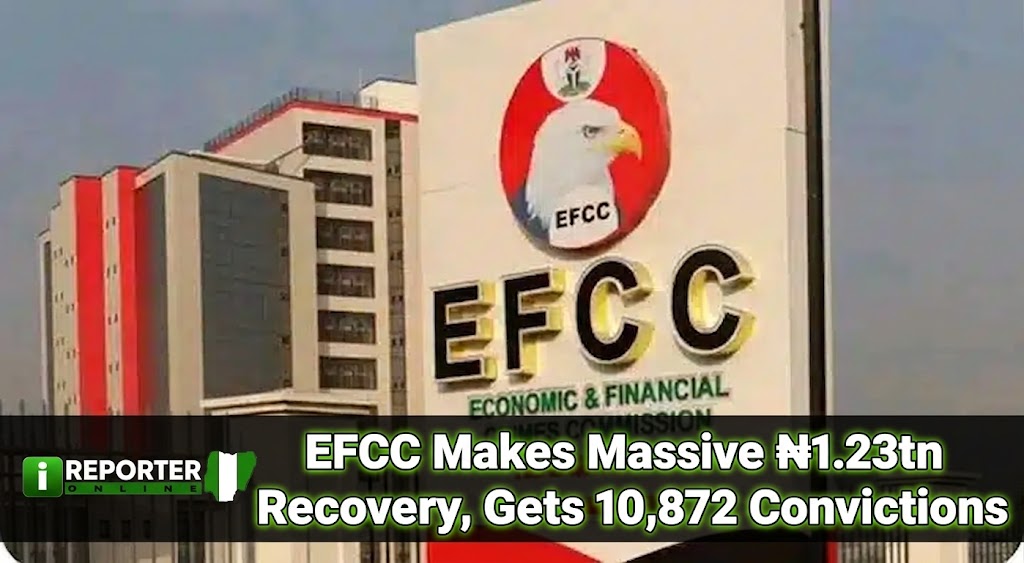
The Economic and Financial Crimes Commission (EFCC) has recovered more than ₦1.23 trillion and $684.47 million in proceeds of crime during the first 34 months of Ola Olukoyede’s tenure as chairman.
According to a performance report presented by Olukoyede on Monday, August 31, 2026, the commission recorded significant progress in investigations, prosecutions, asset recovery, restitution and internal reforms during the period.
Olukoyede disclosed the figures at the EFCC headquarters in Abuja, noting that the commission had intensified its efforts to combat economic and financial crimes across the country.
Between October 2023 and July 2026, the EFCC received 49,673 petitions and investigated 39,615 cases. During the same period, the commission filed 14,476 cases in court and secured 10,872 convictions, representing a 75.1 per cent conviction-to-filing rate.
In the first six months of 2026 alone, the commission obtained 1,370 convictions from 1,889 cases filed before the courts.
The EFCC also reported a notable increase in cases involving cybercrime and advance-fee fraud. Its data covering 2024 to 2026 year-to-date recorded 46,288 offences across nine major categories, with cybercrime and advance-fee fraud accounting for nearly two-thirds of the cases.
The number of recorded offences increased by 24.1 per cent between 2024 and 2025, with notable increases in procurement fraud, bank fraud, cybercrime and economic governance-related offences.
The commission said its investigations and prosecutions continued to cover cases involving former governors, ministers, public officials, heads of government agencies, financial-sector operators and corporate executives.
Among the high-profile cases highlighted were those involving former Minister of Power Saleh Mamman, former NEXIM Bank Managing Director Robert Orya and former Executive Secretary of the National Health Insurance Scheme, Chukwunyere Nwabuoku.
The EFCC also recorded 920 specialised cases involving money laundering, unlicensed bureau de change operations, illegal mining, virtual assets and terrorist financing. The cases resulted in 212 convictions, while others remained under investigation or prosecution.
On asset recovery, the commission said it recovered ₦1,233,612,040,411.11, $684,478,457.32, £373,905.78 and €9,343,803.66 between October 1, 2023, and June 30, 2026, excluding recoveries made in other currencies.
Of the recovered naira, approximately ₦397.26 billion was recovered directly for the Federal Government, while about ₦836.34 billion was recovered on behalf of ministries, departments and agencies, state revenue services, companies, individuals and foreign victims.
The commission further disclosed that ₦661.32 billion and $492.37 million from recovered proceeds had been released to beneficiaries during the period under review.
About ₦325.35 billion of the naira disbursement went to individuals and corporate organisations, while approximately ₦335.97 billion was released to government agencies, revenue authorities, public institutions, companies and other beneficiaries.
The EFCC also reported approximately ₦288.1 billion in tax recoveries for federal and state governments. Federal tax recoveries accounted for about ₦173.2 billion, while state internal revenue services recorded approximately ₦114.9 billion.
The commission stressed that the tax recoveries resulted from the enforcement of existing tax obligations rather than the introduction of new taxes.
A further ₦257.2 billion in naira recoveries was recorded for federal ministries, departments and agencies.
Recovered funds and assets were also channelled into government programmes and public institutions. The Federal Government had earlier approved ₦50 billion from EFCC recoveries for the Nigerian Education Loan Fund and another ₦50 billion for the Nigerian Consumer Credit Corporation. An additional ₦50 billion allocation each to the two programmes was approved in 2026.
The commission also highlighted the conversion of a recovered private university in Kachia, Kaduna State, into the Federal University of Applied Sciences, Kachia. The institution matriculated 1,909 students in December 2025.
According to the EFCC, the development demonstrated how recovered assets could be converted into institutions that provide lasting public value.
The commission secured forfeiture orders covering 10,053 assets between October 2023 and July 2026. The assets included 8,198 electronic items, 1,177 real estate properties, 370 vehicles and 251 plots of land.
Other forfeited assets included schools, factories, hotels, shops, aircraft, oil rigs, barges and machinery. The commission also recorded the forfeiture of 102 tonnes of solid minerals.
The disposal of assets that had received final forfeiture orders generated approximately ₦12.07 billion, which was paid into the Federal Government’s coffers.
Olukoyede also linked the EFCC’s enforcement activities to Nigeria’s broader efforts to strengthen its financial crime control system.
He said the country’s work in areas including money laundering, terrorist financing, asset freezing, confiscation and virtual assets contributed to the wider efforts that led to Nigeria’s removal from the Financial Action Task Force Grey List in October 2025.
The commission recorded 234 cases involving bureaux de change and secured 73 convictions during the period. It said enforcement against unlicensed operators was aimed at reducing avenues for illicit financial activities and promoting greater transparency in the foreign exchange market.
International cooperation also remained an important part of the EFCC’s operations. The commission collaborated with law-enforcement agencies and regulators in Nigeria and other countries, including the United States Federal Bureau of Investigation, United Kingdom National Crime Agency, Royal Canadian Mounted Police and INTERPOL.
The EFCC said some recovery operations involved multiple countries, with recovered funds and assets returned to foreign governments, organisations and individuals where applicable.
At the regional level, Olukoyede was re-elected president of the Network of National Anti-Corruption Institutions in West Africa for another three-year term.
The commission also introduced several internal reforms during the period, including new guidelines on arrest and bail, a review of its sting operations and the creation of specialised units focused on fraud risk assessment, security, immigration and visa matters, and cybercrime response.
It commissioned directorates in Enugu and Ilorin and established new directorates in Ekiti, Anambra and Katsina states to improve access to its services.
The EFCC also introduced policies covering gifts and hospitality, conflicts of interest and the security of exhibits.
Its Internal Affairs Department was restructured and renamed the Ethics and Integrity Department as part of efforts to strengthen ethical standards within the commission.
Digital transformation has also featured prominently in the agency’s reform programme, with the EFCC reporting that about 60 per cent of its processes and operations have been digitalised.
The commission said it was also investing in its academy, the 24/7 Cybercrime Rapid Response Centre and EFCC Radio to strengthen its capacity to respond to emerging and increasingly sophisticated forms of financial crime.

-

 Latest News2 weeks ago
Tinubu Govt Declares Nationwide Public Holiday For Nigerians
-
 Entertainment1 week ago
₦800,000, ₦5m, $11,000: Ogogo’s Daughter Accuses Nigerians Of Exploiting Father’s Cancer
-

 Latest News2 weeks ago
Tinubu Meets Akpabio, Doguwa, Oyetola, Alake At Aso Rock
-

 Latest News1 week ago
Uzodinma Won’t Market Tinubu To Igbos’ – Oshiomhole Reveals Who Should Help
-

 Latest News1 week ago
APC Chairman Collapses, D!es
-
 Latest News1 week ago
Tinubu Renews Appointments In NTA, NAN
-

 Latest News7 days ago
FG Announces New Appointment
-

 Entertainment2 weeks ago
Ogogo’s Family Breaks Silence, Debunks Viral D**th Rumour
-

 Latest News1 week ago
Tinubu Reviews APC Campaign Council Over ‘Corrupt’ Names — See Who Escaped the Shake-Up
-

 Entertainment1 week ago
‘Please Forgive Me’ – Ijebu Begs Colleagues After Ogogo’s D**th
-
 Latest News5 days ago
Malami Sends Strong Message To ADC Members Ahead Of 2027 Elections
-

 Latest News1 week ago
Full List: Meet Members Of New Fake Agency Uncovered By ICPC