Connect with us

Latest News

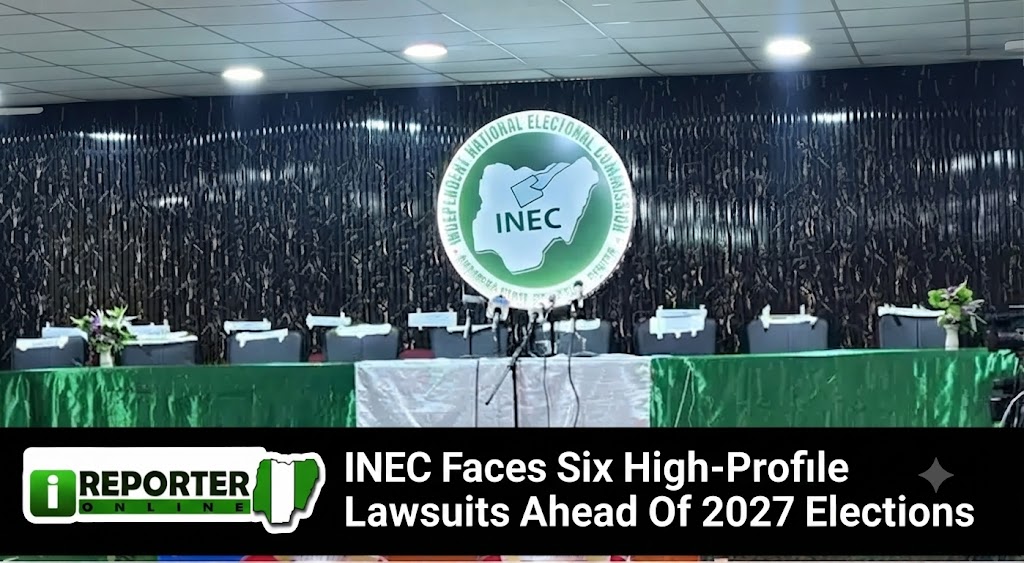
INEC Faces Six High-Profile Lawsuits Ahead Of 2027 Elections

Published

on

871f586a 0f58 4fc0 a3e8 268c1db63642

The Independent National Electoral Commission (INEC) is currently contending with at least six significant legal disputes that could shape preparations for Nigeria’s 2027 general elections. According to Ireporter Online, the cases, which are before the Federal High Court and the Court of Appeal, question the commission’s constitutional powers, aspects of its revised election timetable, and the legal standing of some registered political parties.

The legal battles come just months after INEC unveiled its revised timetable for the 2027 polls, which outlines deadlines for political parties to submit membership registers, conduct primary elections, nominate candidates, and commence campaigns. Under the schedule, presidential and National Assembly elections are slated for January 16, 2027, while governorship and state Assembly elections will take place on February 6, 2027.

Among the most prominent cases is a suit filed by the Youth Party, which challenged several provisions of INEC’s revised timetable. The party argued that the commission exceeded its legal authority by introducing deadlines that allegedly conflict with timelines guaranteed under the Electoral Act. The Federal High Court ruled in favour of the party, declaring that while INEC possesses constitutional powers to organise elections and issue guidelines, such authority cannot override timelines specifically provided by law. The court consequently nullified the disputed portions of the timetable and restrained the commission from enforcing them.

INEC has since appealed the judgment, insisting that its election timetable functions as a coordinated programme where every stage—from party registration and primaries to candidate nominations and campaigns—is interconnected. The commission argued that removing individual timelines could create uncertainty and disrupt preparations for the 2027 elections. The Court of Appeal has heard arguments from both parties and reserved judgment.

Advertisement

A similar legal challenge was instituted by the Social Democratic Party (SDP), which also questioned provisions relating to the nomination and substitution of candidates. Although the Federal High Court acknowledged INEC’s authority to issue election timetables, it ruled that the commission could not alter statutory timelines established under the Electoral Act. INEC has equally appealed the decision, maintaining that the timetable is essential for the orderly conduct of elections. Judgment in the appeal has also been reserved.

Both appeals have emerged as some of the most consequential pre-election cases ahead of 2027, with the Court of Appeal expected to determine the extent of INEC’s powers to prescribe administrative timelines beyond those expressly provided in the Electoral Act. The outcome is anticipated to have a significant impact on the ongoing electoral process before campaigns move into full swing.

Another major dispute concerns a suit filed by the Incorporated Trustees of the National Forum of Former Legislators, seeking the deregistration of the African Democratic Congress (ADC), Accord, Action Alliance, Action People’s Party, and Zenith Labour Party. The Federal High Court ordered INEC to deregister the parties, but the Court of Appeal later granted a stay of execution pending the determination of appeals filed by the affected parties, allowing them to retain their legal status for the time being.

A separate case also challenges the registration of the Nigeria Democratic Congress (NDC). The plaintiff, Ahidjo Ibrahim Karlahi, is asking the court to determine whether the party’s registration complied with constitutional and statutory requirements. The matter remains pending and could influence the party’s eligibility before the publication of the final list of candidates later this year.

Advertisement

Meanwhile, the five political parties facing deregistration have also approached the Court of Appeal to overturn the Federal High Court’s decision. During proceedings on July 7, 2026, the appellate court adjourned the matter until July 14 to allow parties complete the exchange of necessary court documents. The eventual ruling will determine whether the parties remain eligible to sponsor candidates for the 2027 elections.

Legal experts have offered differing opinions on the implications of the ongoing litigation. Senior lawyer Mike Ahamba expressed confidence that the Court of Appeal would deliver its judgments within the constitutional timeframe while declining to speculate on the likely outcome. Another Senior Advocate of Nigeria, Bankole Akomolafe, argued that the pending suits would not derail INEC’s timetable, noting that the commission had prudently continued receiving nominations from political parties pending the final decisions of the courts.

Despite the legal challenges, INEC has reaffirmed its commitment to following its approved election schedule. National Commissioner Mohammed Kudu Haruna stated that political party primaries had already concluded and that the commission remained focused on receiving candidates’ names before the July 11 deadline. He stressed that while INEC would fully comply with any eventual court rulings, it would continue implementing its timetable until directed otherwise by the courts.

Advertisement
Click to comment
Subscribe
Notify of
guest
0 Comments
Oldest
Newest Most Voted

Trending

0
Would love your thoughts, please comment.x
()
x