

Business
Dangote’s Dollar Demand Sparks Fresh Fuel Price Hike

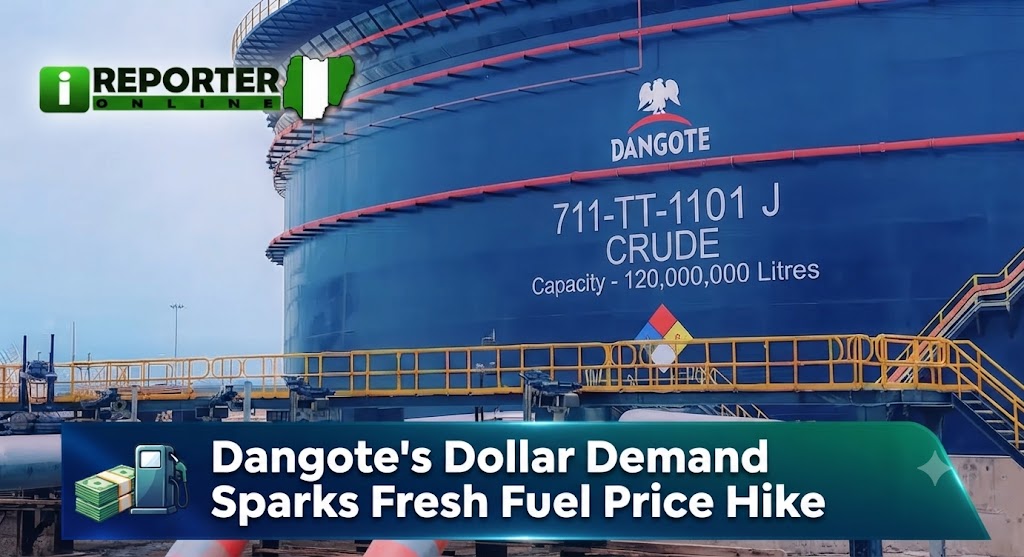
The price of Premium Motor Spirit (PMS), popularly known as petrol, has increased by more than ₦100 per litre at several depots following Dangote Petroleum Refinery’s decision to begin selling its refined petroleum products in United States dollars.
According to Ireporter Online, the new pricing policy is expected to compel petroleum marketers to source an estimated $1.84 billion every month to purchase petrol, diesel and aviation fuel from the refinery, a development that has sparked concerns over increased pressure on Nigeria’s foreign exchange market and the likelihood of higher fuel prices nationwide.
Energy experts and stakeholders in the downstream petroleum sector warned that the shift from naira to dollar transactions could intensify demand for foreign exchange, strain liquidity within the FX market and expose consumers to more frequent fluctuations in pump prices.
The impact of the policy has already been felt across several depots, where the ex-depot price of petrol reportedly climbed from about ₦1,137 per litre to as high as ₦1,250 per litre, representing an increase of ₦113. Other facilities, including Sahara, AIPEC and African Terminal, also adjusted their loading prices from about ₦1,090 to between ₦1,120 per litre. Diesel prices were equally revised upward, with some depots raising ex-depot rates by as much as ₦150 per litre to approximately ₦1,650.
Industry estimates indicate that marketers will now require roughly $60.7 million daily to purchase petroleum products from the refinery. Petrol accounts for the largest share of the demand, with marketers expected to spend about $36.9 million daily, equivalent to nearly $1.1 billion monthly, based on the refinery’s new gantry price of $0.779 per litre. Diesel purchases are projected to require approximately $20.4 million daily, while aviation fuel could consume an additional $3.4 million each day.
Analysts believe the development will test the capacity of Nigeria’s banking system and foreign exchange market to meet the substantial dollar requirements of numerous downstream operators within short periods.
The increase in depot prices comes despite the Federal Government’s recent call for a reduction in fuel costs and coincides with a rise in global crude oil prices to about $85 per barrel.
Dangote Petroleum Refinery had earlier notified customers that, effective July 13, all payments for petroleum products lifted from its gantry would be made in dollars. The company subsequently cancelled all previously issued naira invoices and introduced new dollar-based prices, fixing PMS at $0.779 per litre, diesel at $1.087 per litre and aviation fuel at $0.942 per litre, while clarifying that Liquefied Petroleum Gas (LPG) transactions would remain under the existing payment arrangement.
The latest move effectively transfers foreign exchange risks to marketers, who generate revenue in naira but must now obtain dollars before purchasing products. The decision also marks a departure from the naira-based sales framework introduced under the Federal Government’s naira-for-crude initiative launched in October 2024 to reduce pressure on the FX market and encourage local refining.
Industry sources believe the return to dollar pricing may be linked to persistent challenges in securing adequate domestic crude oil supplies, forcing the refinery to rely more heavily on imported crude purchased in foreign currency.
Founder of Energy Business Analytics, Dr. Kaase Gbako, said the policy suggests increasing pressure on the naira-for-crude initiative and warned that the foreign exchange burden has effectively shifted from crude suppliers to marketers and, ultimately, consumers. He noted that marketers are likely to pass the additional costs of sourcing dollars to end-users, resulting in higher pump prices.
Professor Emeritus of Petroleum Economics and Executive Director of the Emmanuel Egbogah Foundation, Prof. Wumi Iledare, described the decision as consistent with the realities of a deregulated petroleum market but cautioned that it could introduce fresh operational and macroeconomic challenges. He explained that marketers would now need stronger foreign exchange procurement strategies and predicted more frequent price adjustments as operators respond to exchange-rate movements and global oil prices.
Former President of the Nigerian Economic Society, Prof. Adeola Adenikinju, also warned that the policy could place additional pressure on the naira and increase inflation, noting that domestic fuel procurement now resembles importation because marketers must secure foreign currency before buying products from a refinery located within Nigeria.
Country Manager for Tradegrid, Jide Pratt, acknowledged that Dangote Refinery’s Free Trade Zone status legally permits dollar transactions but questioned the return to foreign currency pricing after the implementation of the naira-for-crude initiative. He argued that products refined from crude supplied under the naira arrangement should ideally continue to be sold in the local currency, calling for greater transparency in linking crude sourcing with product pricing.
Similarly, the Managing Director of the Centre for the Promotion of Private Enterprise, Dr. Muda Yusuf, identified currency mismatch as the biggest challenge facing marketers. He maintained that while the refinery’s decision is commercially understandable due to its reliance on imported crude, the overall impact on pump prices will largely depend on exchange-rate stability and international crude oil prices.
Petroleum marketers have, however, expressed fears that the policy could gradually lead to the dollarisation of Nigeria’s downstream petroleum sector. The National President of the Petroleum Products Retail Outlets Owners Association of Nigeria, Dr. Billy Gillis-Harry, questioned whether marketers would now have to source dollars from the Central Bank of Nigeria to purchase petroleum products produced locally, while the National President of the Independent Petroleum Marketers Association of Nigeria, Shettima Maigandi, said independent marketers would face significant challenges converting their naira earnings into dollars before purchasing products.
Stakeholders maintain that although the refinery’s decision reflects the commercial realities of a deregulated oil market, it raises fresh concerns about the sustainability of the naira-for-crude policy and could place additional pressure on Nigeria’s foreign exchange market unless crude supply, pricing mechanisms and currency policies are made more transparent.

-

 Latest News1 week ago
Tinubu Govt Declares Nationwide Public Holiday For Nigerians
-

 Entertainment7 days ago
₦800,000, ₦5m, $11,000: Ogogo’s Daughter Accuses Nigerians Of Exploiting Father’s Cancer
-

 Latest News2 weeks ago
Tinubu Meets Akpabio, Doguwa, Oyetola, Alake At Aso Rock
-

 Latest News2 weeks ago
INEC Makes Fresh Announcement After Declaring Adeleke Winner Of Osun Election
-

 Latest News1 week ago
APC Chairman Collapses, D!es
-

 Latest News6 days ago
Uzodinma Won’t Market Tinubu To Igbos’ – Oshiomhole Reveals Who Should Help
-

 Latest News7 days ago
Tinubu Renews Appointments In NTA, NAN
-

 Latest News5 days ago
FG Announces New Appointment
-

 Entertainment2 weeks ago
Ogogo’s Family Breaks Silence, Debunks Viral D**th Rumour
-

 Latest News5 days ago
Tinubu Reviews APC Campaign Council Over ‘Corrupt’ Names — See Who Escaped the Shake-Up
-

 Entertainment6 days ago
‘Please Forgive Me’ – Ijebu Begs Colleagues After Ogogo’s D**th
-

 Latest News3 days ago
Malami Sends Strong Message To ADC Members Ahead Of 2027 Elections